By Vivienne Calloway
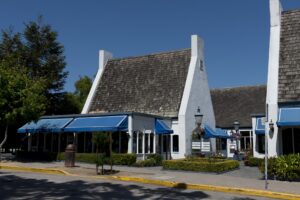
There is a particular hush that settles over a room built for children the moment it fills, instead, with music. You feel it at Sunset Center on a concert evening — the way the light catches the steep Tudor gables, the way the arches seem to lean in to listen. A century ago, this was a place where Carmel’s children learned to read. This year, as the building quietly marks one hundred years since its cornerstone was laid, it stands as the Monterey Peninsula’s most beloved stage, and it has just unveiled a season worth planning a year around.
A century of good bones
The story begins in January of 1926, when the Sunset School opened its doors with civic ceremony and no small amount of local pride. The commission had gone to the Oakland architect John J. Donovan, a designer of schools and civic buildings who gave Carmel something more romantic than a classroom block. His U-shaped plan, executed by the Sacramento contractors Herndon and Finnigan, rose in the Tudor Revival manner then beloved on the Peninsula: stucco walls, pointed arches, and steeply pitched cross-gabled roofs that would not have looked out of place in an English village. It was, in other words, exactly the sort of building Carmel wanted to be seen in — bohemian, storybook, and just a little theatrical, long before there was a stage inside it.
For four decades it did the honest work of a school. Then, in 1965, the City of Carmel-by-the-Sea purchased the property with a larger idea in mind: a home for the arts. The transformation was gradual, and for years the old school led a double life as a community hall and rehearsal space, its acoustics more accidental than designed. Recognition of its architectural worth arrived in 1998, when the building was entered on the National Register of Historic Places — a formal acknowledgment that this was a structure worth keeping, and keeping well.

The restoration that changed everything
The building we cherish today owes its voice to an ambitious restoration at the turn of the millennium. Carried out through a public-private partnership — the City of Carmel and a devoted circle of private donors together underwriting the work — the project reimagined the old auditorium as a genuine concert hall while preserving Donovan’s historic envelope. In 2003, the nonprofit Sunset Cultural Center was formed to steward and operate the reborn theater, and the results speak for themselves: an intimate house of roughly 718 seats, acoustics that flatter a solo violin and a full chorus alike, and a sense, rare in modern halls, that every seat belongs to a conversation rather than a crowd.
That intimacy is the whole point. Carmel has never wanted a coliseum. It wants a room where a listener in the last row can still read the expression on a soloist’s face — and that is precisely what a century of good bones, thoughtfully restored, has delivered.
The 2026–2027 Sunset Presents season
Into that room comes a new “Sunset Presents” season, the center’s own curated series of touring artists and one-night occasions. The programming ranges wide by design, gathering Grammy-honored musicians, Broadway voices, and family evenings under a single marquee, with the promise — familiar to season regulars — that more names will be added as the calendar unfolds.
Among the confirmed pleasures are two American originals separated by genre but united in craft. On September 11, 2026, the blues guitarist Kenny Wayne Shepherd brings his particular brand of electric fire to the Sunset stage. Later, on October 30, 2026, the incomparable Lyle Lovett arrives with his Large Band, that gloriously loose-limbed ensemble through which he has spent a career blurring the borders between country, swing, gospel, and jazz. To hear Lovett in a 718-seat room is to hear him roughly as a songwriter hopes to be heard — every wry aside intact.
The through-line of the season is that scale. These are artists who could fill far larger houses, choosing instead a hall where the music arrives unmediated. It is the closest thing the Peninsula offers to hearing a great performer in one’s own living room, if one’s living room happened to be a hundred-year-old Tudor landmark.
The Symphony’s stellar year
No account of a Sunset Center season would be complete without the orchestra that calls it home. The Monterey Symphony has announced its 81st season, with six concert sets at Sunset Center under its music director, Jayce Ogren — and by his own description, the lineup is “absolutely stellar.”
He has reason for confidence. Two significant debuts anchor the year: the pianist Jonathan Biss, whom Ogren calls “one of America’s greatest living pianists,” and the violinist Alexi Kenney, “a young superstar.” Returning to Carmel are the married pianists Ran Dank and Soyeon Kate Lee, appearing as a duo in Dvořák’s sunlit Slavonic Dances and the world premiere of a work for two pianos and orchestra by the Chinese-American composer Chen Yi — a genuine event, and the kind of commission a small orchestra undertakes only when it believes deeply in the music.
The repertoire is a connoisseur’s comfort and a newcomer’s delight in equal measure: Tchaikovsky’s Symphony No. 5, Copland’s Appalachian Spring, Beethoven’s Fourth Piano Concerto. In March comes the season’s grand gesture — all four Brahms symphonies performed across a single weekend, a rare chance to hear these towering works in close conversation with one another. And in May, the Symphony’s ongoing collaboration with the San Francisco chorus VOLTI culminates in Verdi’s dramatic Te Deum paired with Mahler’s overwhelming Symphony No. 2, the Resurrection — the first time in its history the Monterey Symphony will perform that beloved score.
Symphony single tickets range from $50 to $90, with a generous $12 admission for students, teachers, and members of the military; subscriptions open May 1, 2026.
A room that keeps its promises
There is something fitting in all of this. A building raised to educate the young has become, in its second century, a place where audiences of every age come to be moved. The children who first filed through Donovan’s arches in 1926 could not have imagined Mahler filling their auditorium, or a blues guitarist bending notes where the blackboards once hung. And yet the through-line holds: this has always been a room built to gather a community and lift it toward something larger than the everyday.
A century on, the schoolhouse still teaches — only now the lessons are set to music. It is, quite simply, one of the coast’s enduring pleasures, and the year ahead may be its most rewarding chapter yet.