By Julian Marsh
There is a house on Torres Street, near Sixth Avenue, that seems to have wandered out of a bedtime story and decided to stay. Its roofline swoops and sags like a hand-drawn illustration. Its chimney leans. Its plaster ripples as though smoothed by thumbs rather than trowels — which, as it happens, is very nearly the truth. The cottage is called Hansel, it was built in 1924 for about one hundred dollars in materials, and it was never meant to found an architectural tradition. It was meant to house dolls.
That it ended up defining the visual character of an entire village — that visitors a century later still drift through Carmel-by-the-Sea’s residential blocks searching for its gabled descendants — is one of the happiest accidents in California design history. And like most happy accidents, it began with a courtship.
A Rancher, a Dollmaker, and a Hundred Dollars of Lumber
Hugh White Comstock was born on a farm in Evanston, Illinois, in 1893, and came west with his family to Santa Rosa as a boy. In 1924, at age thirty-one, he traveled to Carmel to visit his sister Catherine and her husband, the painter George Seideneck, both active in the young village’s art colony. He intended a visit. Then he met Mayotta Browne.
Mayotta was already a small phenomenon: the designer of the “Otsy-Totsy,” a handmade rag and felt doll popular enough to have become a genuine business. The courtship was swift even by the standards of a town that prized spontaneity — they were married in Salinas that April. And soon Mayotta made a request that would quietly redirect the history of the Monterey Peninsula: she asked her new husband to build a little cottage where she could display and sell her dolls.
Comstock had no formal training in architecture. What he had instead was a farm-raised competence with tools, an evident sense of play, and a set of borrowed dreams — the pen-and-ink worlds of Arthur Rackham, the great English illustrator of Grimm’s fairy tales, Rip Van Winkle, and Alice’s Adventures in Wonderland. Rackham’s cottages never stood plumb. Their roofs draped over the walls like blankets; their windows peered out at crooked angles. Comstock set out to build one in three dimensions.
The result, finished in 1924 for roughly $100 in materials, was the little building the newlyweds called the Doll House — known today as Hansel. Nothing about it is regular. The plaster was troweled on unevenly, with pine needles worked into the finish. The roof curls at the eaves. The whole structure is scaled with a miniaturist’s affection, as though the dolls themselves had commissioned it. A year later, when the Otsy-Totsys had outgrown their quarters, Mayotta asked for a second cottage to serve as her office. Gretel rose beside Hansel in 1925, for the princely sum of $400.
The Style That Escaped the Garden
Carmel in the 1920s was a village of artists, writers, and determined eccentrics, and it took approximately no time at all for the neighbors to fall in love. Residents began asking Comstock to build storybook cottages of their own, and the dollmaker’s husband found himself, almost overnight, a master builder with a signature style.
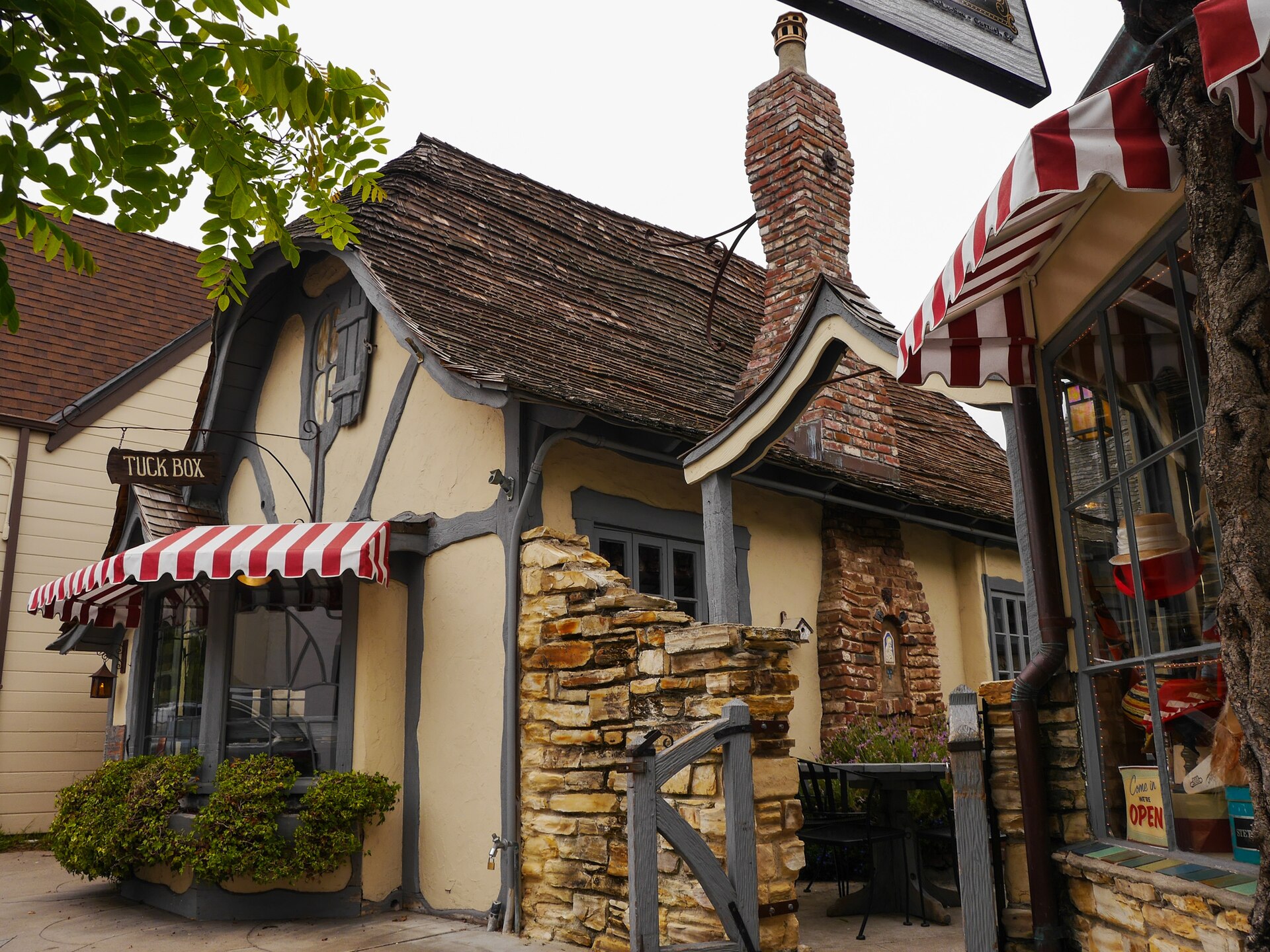
What distinguishes a Comstock cottage is not whimsy alone but the honesty of its materials — and here the builder proved himself a genuine craftsman. He worked with what the land offered: chalk rock hauled from Carmel Valley for battered, deliberately rustic chimneys; hand-carved planks and hand-forged iron fixtures; redwood shingles; heavy timber framing expressed in the walls. Steep gables, half-timbering set into stucco, and leaded diamond-paned windows completed the vocabulary. The effect is medieval England filtered through a child’s memory of it — and it belongs, somehow, entirely to this pine forest above the Pacific.
The commissions multiplied through the late 1920s, and their names read like the contents of a nursery bookshelf: Snow White’s Summer Place, Marchen Haus, Our House, the Birthday House, Fables, Honeymoon Cottage, Curtain Call. In 1926 Comstock gave the style its most public stage with a tiny commercial building on Dolores Street between Ocean and Seventh — a swoop-roofed confection with an unevenly bricked chimney that, since 1941, has served tea and scones as the Tuck Box, named for the trunks British schoolchildren once carried to boarding school. It remains the most photographed few hundred square feet in the village.
In 1927, Comstock built his own studio at Santa Fe Street and Sixth Avenue in the manner of an English country house — the architect at last his own client.
Roughly twenty-one of his original cottages still stand in Carmel today, a remarkable survival rate that says as much about the town’s devotion as about the buildings themselves.
The Second Act: Mud, Timber, and Modernity
Had Comstock stopped there, his legacy would be secure. But the Depression pushed the self-taught builder toward an unexpected second act. With clients scarce and budgets thin, he began experimenting with the most ancient of California materials: adobe. Characteristically, he refused to leave it alone. He developed a stabilized adobe brick he called “Bitudobe” and a construction method that married thick earthen walls to a rugged timber frame — strong, economical, and suited to the coastal climate. He built his first adobe house in 1936, advised the architects Franklin & Kump on the post-adobe construction of Carmel High School in 1938, and in 1948 published a book, Post-Adobe, sharing the method with anyone who cared to try it.
He gave the village his civic energy as well. Comstock drew up the plans for the 1939 WPA reconstruction of the Forest Theater alongside its founder, Herbert Heron. He served for over a decade on the Carmel Sanitary District board, joined the Planning Commission in 1946, and lent his weight to the ordinances — no sidewalks in the residential blocks, no home mail delivery — that still preserve what he and his generation called the forest ambiance. The man who built the fairytale also helped write the rules that protected it.
Hugh Comstock died in Santa Barbara on June 1, 1950, at just fifty-seven. Mayotta, whose dolls started it all, survived him by nearly three decades.
A Century On
In 2024, one hundred years after a newlywed rancher nailed together a doll house in the pines, the Carmel City Council formally proclaimed the centennial of the first storybook cottage, and the Carmel Heritage Society marked the anniversary with a tour of Comstock homes — private residences, most of them, still lived in, still loved. The Heritage Society remains the keeper of this flame, and its walking maps will lead you to the cottages’ doorsteps any day of the year.
Go in the late afternoon, when the light comes low through the pines and the Carmel stone chimneys hold the last of the warmth. Stand across from Hansel and consider what it teaches: that great architecture does not require credentials, that the best buildings are love letters, and that a village becomes a legend one hundred dollars at a time.
Hansel and Gretel are private residences on Torres Street near Sixth Avenue; please admire from the lane. The Tuck Box, on Dolores between Ocean and Seventh, still pours tea daily. Walking-tour information is available through the Carmel Heritage Society.