By Eleanor Whitfield
On a Friday afternoon in Pacific Grove, when the fog has burned back to a thin silver line offshore and the wind combs through the twisted cypress, the door of the old granite lighthouse at Point Pinos stands open. Inside, a docent in a volunteer’s badge waits at the foot of the stairs. There is no crowd, no ticket booth, no velvet rope. There is only the light — a third-order Fresnel lens of French crystal, turning as it has turned, in one form or another, since the winter of 1855 — and the quiet people who make sure the door keeps opening.
Point Pinos is the oldest continuously operating lighthouse on the West Coast of the United States. It was first lit on February 1, 1855, a grey stone outpost set among sand dunes and howling weather at the tip of the Monterey Peninsula. In the century and a half since, the shoreline around it has become a golf links, the whale-oil lamp has given way to electricity, and the keeper’s watch has been replaced by automation. What has not changed is the beam itself, and the remarkable idea that a community should keep it open to anyone who wishes to climb the stairs and see it.
A beacon built to last
The story begins with an act of Congress. After the Mexican-American War brought California into the Union, the federal government moved to light its treacherous new coastline, and in 1852 the Treasury ordered seven beacons built along the shore. One was to stand at Point Pinos, the pine-covered point that guards the entrance to Monterey Bay. The lens — a marvel of prisms and polished glass manufactured in Paris in 1853 — was delayed in its long passage from France, and it was not until February 1855 that the light finally shone across the water.
That original lens still turns today. It has outlasted the sailing ships it was built to guide, the lighthouse service that installed it, and every keeper who ever trimmed its wick. To stand beneath it now is to look at the same crystal that steadied the nerves of a Gold Rush-era sea captain feeling his way toward harbor in the dark.
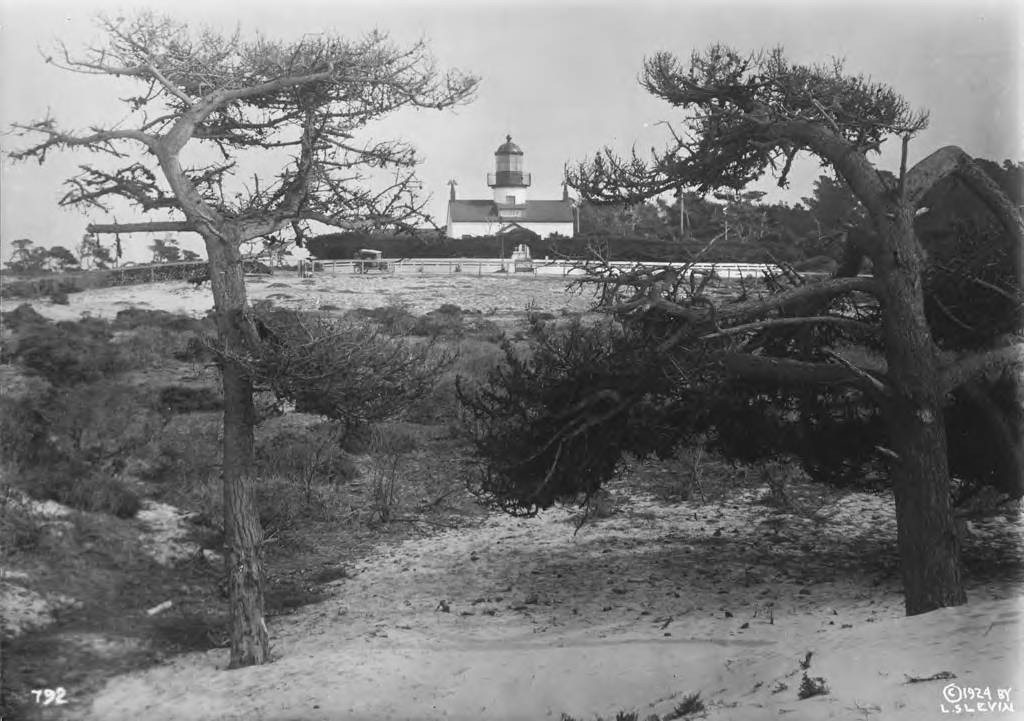
The keepers who came before
Before there were volunteers, there were keepers, and their lives are woven into the walls. The first was Charles Layton, an Englishman who arrived in 1854 with his wife, Charlotte, and their four children, and who watched over the unfinished station until the lens was lit. His tenure was brief and ended in tragedy: in November 1855, riding with a posse in pursuit of a notorious bandit, Layton was shot and died of his wounds.
What happened next set the tone for everything that followed. Rather than send Charlotte and her children away, the citizens of Monterey proposed that she be made keeper — she knew the work, and she had a family to raise. In early 1856 she was appointed, becoming the first woman principal keeper on the West Coast. The light at Point Pinos, from almost its beginning, was tended by a woman who had every reason to leave and chose to stay.
The most storied of them all arrived nearly four decades later. Emily Fish came to Point Pinos in 1893, a widow of fifty who had lived in Shanghai and San Francisco and moved easily through society. History remembers her as the “Socialite Keeper,” and she earned the name. She hauled in rich soil and planted grass, hedges, and trees where there had been only sand. She kept French poodles and Holstein cows, thoroughbred horses and chickens. She entertained the fashionable set of the Peninsula in rooms scented with cut flowers — and, without fail, she received the highest marks the inspectors could give for the tidiness and readiness of her station.
Emily Fish tended the light for twenty-one years, until 1914. Hers was not the only lamp in the family. She had raised her late sister’s daughter, Juliet, as her own, and Juliet Nichols — widowed young when her naval-officer husband died in the Spanish-American War — became keeper of the light at Angel Island, holding that lonely post from 1903 to 1914. Two women, an aunt and her niece, kept two California lights burning at the same time: one amid poodles and dinner parties, the other in near-solitude at the foot of a cliff. Their portraits and belongings are part of what a visitor to Point Pinos comes to see.
The keepers of today
The light was automated in 1975. The last keeper moved out, the Coast Guard took the beam under its remote and tireless watch, and a lighthouse that had always meant a human presence became, in the practical sense, a machine. It might easily have become a locked building admired only from the road.
It did not, and that is the real story of Point Pinos in our own century. The City of Pacific Grove owns the lighthouse and runs it as a museum open to the public. But it is a small and devoted community that keeps the door open week after week — the corps of trained docents who guide visitors up the stairs, the Heritage Society of Pacific Grove, which has overseen the careful restoration of the historic building, and the Pacific Grove Museum of Natural History, whose stewardship helps hold the collection and its stories together. These are volunteers, for the most part: neighbors who give their Friday and weekend hours so that a child from Salinas or a traveler from abroad can stand beneath a 170-year-old lens and understand what it once meant to keep a light.
They are the direct heirs of Charlotte Layton and Emily Fish, though they no longer sleep beside the lamp or rise in the night to trim a wick. Their work is quieter and, in its way, just as essential. A lighthouse the public cannot enter is only architecture. A lighthouse with someone waiting at the bottom of the stairs, ready to tell you about the woman who planted a garden in the sand, is something closer to a living memory.
The lighthouse keeps modest hours — Fridays in the early afternoon, and Saturdays and Sundays through the middle of the day — and the small suggested donation goes back into its care. Restoration continues under the Heritage Society’s supervision, an unending task in a place where salt air works against stone and iron every hour of every year. There is always something to mend, and always someone who has volunteered to mend it.
Late in the afternoon, when the last visitors have gone and a docent turns the key in the old door, the light does not go dark. It never has. It will turn through the night above the golf links and the cypress and the black water of the bay, as it did for Charles Layton and for the wife who took up his post, for Emily Fish and her poodles, for every ship that ever mistook the fog for the open sea. And on Friday, someone will come to open the door again.