By Eleanor Whitfield
By ten o’clock on a Thursday in July, the light has already done its slow work through the oaks along Sixth Avenue. It comes down in coins and ribbons, catching the edge of a folding table here, the shoulder of a canvas awning there, and warming the pavement between Junipero and Mission until the whole block seems to exhale. This is the hour the Carmel Farmers’ Market begins to fill, and for the next four hours the street will belong not to cars but to conversation.
There is nothing grand about the setup. A row of white canopies, a scatter of wooden crates, hand-lettered signs propped against baskets. And yet in deep summer, when the Salinas Valley is sending up everything it has, this modest stretch of village becomes something close to a living room — the place where Carmel comes to see itself.
The abundance of the valley
The Peninsula keeps its own cool counsel through July, fog lingering at the edges of the morning, but a short drive inland the Salinas Valley is at full throttle. They call it the salad bowl of the world, and by midsummer the phrase stops being a boast and becomes a plain description of the tables here. Strawberries in flats still warm from the field. Heirloom tomatoes in improbable colors — sunset orange, deep oxblood, a green so pale it looks lit from within. Stone fruit stacked in careful pyramids, peaches and nectarines and the first of the season’s plums. Sweet corn, sold by the armful. Basil in bunches so generous the whole corner smells of it.
The growers arrive early and unhurried, the way people do when they have done a thing many times. They stack and straighten and taper their pyramids of fruit, tucking a bruised peach to the back, turning the best face of the tomato toward the street. It is a kind of craftsmanship, this arranging, though none of them would call it that. It is simply how you show a season’s work.
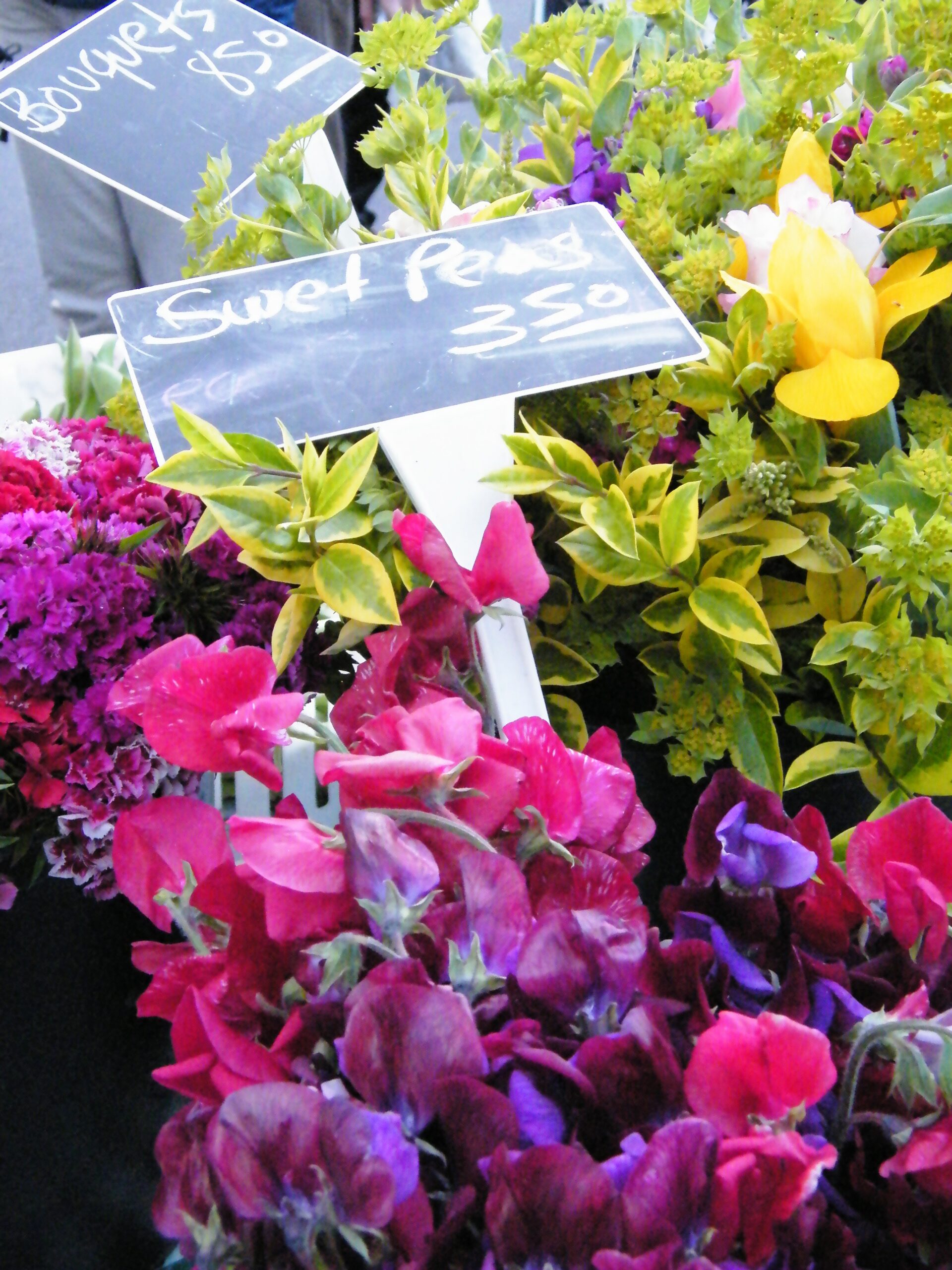
The market has been operating on this rhythm for years now, run by Good Roots, Inc. and held every Thursday from ten until two. Alongside the produce come the specialists — olive oil pressed from Central Coast groves, honey, fresh bread still holding the morning’s warmth, hummus, wood-fired pizza turned out to order. Fresh-cut flowers stand in buckets at the market’s edge, dahlias and sunflowers and sweet peas, so that more than one shopper leaves with a loaf under one arm and a bouquet under the other.
The village’s living room
What sets a market like this apart from a grocery aisle is not the produce, though the produce is remarkable. It is the pace. No one is in a hurry. A woman stops at a stall she has visited for a decade and is handed a wedge of nectarine to taste before she has said a word. Two neighbors meet in the middle of the street and stand there talking, baskets against their hips, while the market flows around them like water around a stone. A child is lifted to see over the lip of a crate. A retired couple debates the merits of one basil bunch over another with the seriousness of a museum acquisition.
These are the small liturgies of a place that still knows itself. In an age when so much of what we eat arrives anonymous and out of season, there is something quietly radical about buying a peach from the hand that grew it, in the week it ripened, a few miles from where it hangs. The transaction is almost beside the point. What is really being exchanged is a kind of belonging.
You notice, too, how the market gathers the village’s other threads. Sustainable Carmel is often on hand near the food-scrap bins, ready to talk composting to anyone who lingers. Community groups set up folding tables to raise awareness for the causes that move a small town — the library, the creek, the trees. The market has become, without anyone quite deciding it should, the closest thing Carmel has to a town square: a place to buy dinner, yes, but also to learn what your neighbors are worrying about and hoping for.
The particular magic of midsummer
Every season has its character here. Spring brings asparagus and the first strawberries and a certain nervous optimism. Autumn brings squash and apples and the low gold light. But July is the market at its most lavish, the moment when the tables can barely hold what the valley is producing and the choosing becomes genuinely difficult.
It is the season of the impromptu meal, assembled entirely from what caught the eye between one canopy and the next. A tomato, still warm, eaten out of hand before you reach the car. Corn for the grill. A wedge of melon that perfumes the whole tote bag. Flowers for a table that has no occasion but the day itself. This is Peninsula abundance at its peak, and the people who shop here know to take it while it lasts, because they have learned that the fog will return and the season will turn and next Thursday the peaches may already be giving way to something else.
By early afternoon the crowds thin. The growers begin the slow reverse of the morning, collapsing canopies, stacking the emptied crates, tallying what the day has left them. The flower buckets stand lower. The bread is long gone. The light has climbed high enough now that the oaks throw their shade straight down.
And on the pavement where a tomato pyramid stood all morning, someone has left a single strawberry — bright, perfect, forgotten in the rush — waiting for the sweep of a broom, or the notice of a passing sparrow, the last small evidence that summer came to Sixth Avenue and set out everything it had.
The Carmel Farmers’ Market is held Thursdays, 10 a.m. to 2 p.m., on Sixth Avenue between Junipero and Mission Streets in Carmel-by-the-Sea. The market is operated by Good Roots, Inc.