By Julian Marsh
There is a particular pleasure, in Carmel-by-the-Sea, in the moment you step off Ocean Avenue and the town seems to fold inward around you. One moment you are on the wide, tree-shaded main street; the next you have slipped through a stone archway or a gap between two shopfronts, and the noise falls away. Brick underfoot, ivy overhead, a fountain somewhere just out of sight. You have entered one of the village’s courtyards — a room without a roof, built for lingering — and you understand, almost at once, why this square mile of coastline has stayed enchanting for a century.
Carmel is a town that rewards the wanderer. Its most memorable spaces are not the ones announced from the street but the ones you have to find: tucked courtyards, brick paseos, flower-hung passageways that thread between buildings and open, unexpectedly, onto a hidden terrace. They are the village’s interior world, and they are no accident. They are the expression of a design philosophy — human-scaled, unhurried, a little theatrical — that has shaped Carmel from its earliest days and still governs how the place feels today.
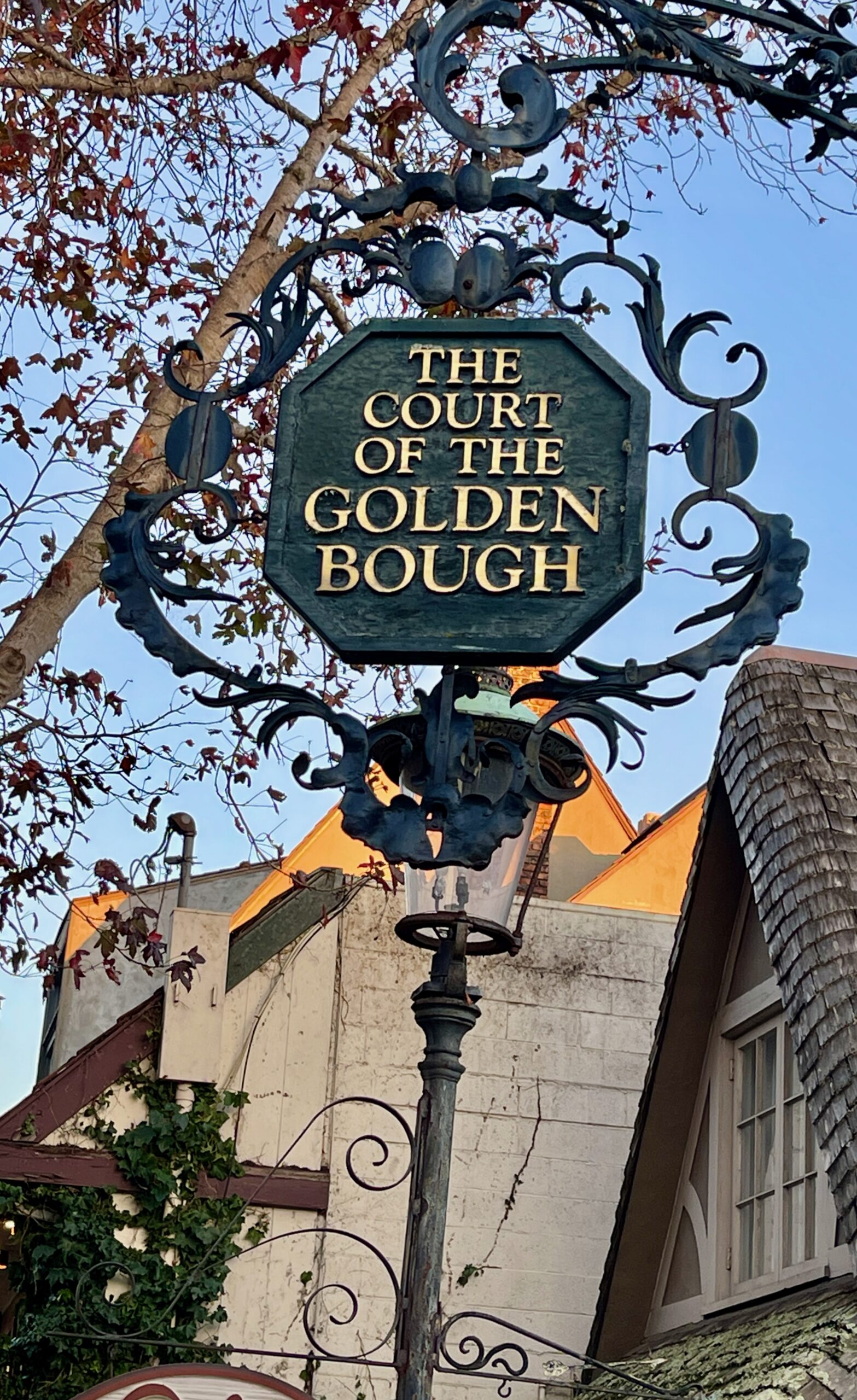
The Court of the Golden Bough
Begin, as so many do, at the Court of the Golden Bough, on Ocean Avenue between Lincoln and Monte Verde. The name carries a whiff of myth, and deliberately so. It comes from the golden branch of Roman legend — the bough that carried Aeneas safely through the underworld — and it was chosen by Edward G. Kuster, a Los Angeles musician, lawyer, and man of the theatre who arrived in Carmel in 1920 determined to build a playhouse of his own.
Kuster’s Theatre of the Golden Bough opened on Ocean Avenue on June 6, 1924, an ambitious auditorium of some 360 seats furnished, in the Carmel spirit, with wicker armchairs. In front of it he laid out a court of shops — the entrance sequence to his theatre, a threshold between the street and the stage. When fire destroyed the theatre in 1935, arson suspected, the auditorium was lost but the idea survived. Kuster carried the Golden Bough name to a playhouse on Monte Verde Street, where it endures today under Pacific Repertory Theatre, which has run the complex since 1994.
The court itself passed into other hands — Kuster sold it in 1950 — and evolved into what visitors find now: an arcade of shops gathered around the surviving facade of that first theatre, opening into a courtyard of brick and shadow. Passages branch off it like the wings of a stage set. There is something fitting in that. Kuster was a theatre man, and his court was always, at heart, a piece of scenography — a space designed to slow you down, frame a view, and make an ordinary errand feel like an entrance.
Su Vecino Court
Walk north of Ocean and you find a gentler, more domestic version of the same instinct. Su Vecino Court — the name means “your neighbor” — runs between Lincoln and Dolores, its passageway swelling into the leafy expanse of El Prado before releasing you onto the far street. It grew up, in the neighborly way Carmel favors, around the terrace of Su Vecino’s, a Mexican restaurant opened in the 1950s by August and Louisa Nieto. The courtyard took its character from that terrace: a place to sit, to gather, to be among others without hurry.
The village’s connection to the movies runs quietly through here too. Su Vecino’s terrace was, for years, home to the serape Clint Eastwood wore in Sergio Leone’s 1966 western The Good, the Bad and the Ugly — a small, storied artifact in a town that later elected Eastwood its mayor. Today the court still trades in that same easy conviviality, its passageways hung with vines and its corners furnished for conversation. It is craftsmanship of a subtle kind: the deliberate making of a place that feels found rather than built.
The Doud Arcade
Newer, but cut from the same cloth, is the Doud Arcade, which threads from Ocean Avenue through to San Carlos Street. Completed in 1961 by Jim and Toland Doud, it was conceived from the start as a home for makers — local craft studios and small shops, an artisan enclave under one long roofline. That spirit has proved durable. The heart of the arcade is its interior courtyard, floored in warm red tile, where the hush of a working studio still settles over the space. Here the courtyard idea turns explicitly toward craft: not a stage, not a terrace, but a workshop opened to the passing eye.
A philosophy written in brick and timber
What unites these three places — a theatre court from the 1920s, a restaurant terrace from the 1950s, a craft arcade from the 1960s — is a shared refusal of the ordinary grid. Carmel was founded by people who wanted their village to remain a village. Its founders famously rejected house-to-house mail delivery in favor of a central post office, unwilling to see the town become, in the language of the day, “citified.” For more than a century homes went without street numbers, identified instead by poetic names or by their position relative to the nearest corner. Residents still gather their mail at the post office, a daily ritual of encounter that the town has been reluctant to surrender even as official addresses have lately, at last, been assigned.
That same impulse — to keep the human being at the center of things — is what produced the courtyards. A town without street numbers is a town that expects you to know it by feel, to navigate by landmark and memory rather than by signage. The courtyards reward exactly that kind of intimate knowledge. They are not visible from a passing car. They ask to be discovered on foot, at walking pace, by someone willing to turn down a passage on instinct.
The materials tell the story too. Brick and terra-cotta tile underfoot, timber and stucco overhead, the whole thing kept low and close and green — this is architecture scaled to the body, to the reach of an arm and the height of an eye. Nothing towers. Nothing hurries. Light filters down through canopy and trellis and lands in dappled patches on old brick. The coastal fog that rolls in off Carmel Bay softens every edge and deepens every shadow, and the courtyards, sheltered and inward-facing, hold their warmth against it.
The Carmel Heritage Society and generations of vigilant residents have worked to protect this character, and it shows. To walk the courtyards today is to move through a design idea that has been tended, not merely preserved — kept alive by the shopkeepers, restaurateurs, and craftspeople who still fill them. Kuster’s court, the Nietos’ terrace, the Douds’ arcade: each was made by particular people, for the pleasure of gathering, and each still does the work it was built to do.
That is the enduring lesson of Carmel’s hidden interior. The village’s magic was never loud. It was built, quietly, one passage and one courtyard at a time — a legacy of makers who understood that the most enchanting places are the ones you have to slow down to find.