By Julian Marsh
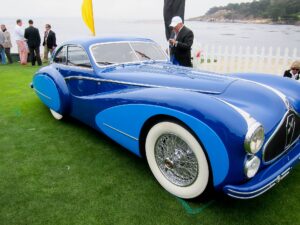
There is a particular hour on the third Sunday of August when the fog lifts off Carmel Bay and the morning light comes in low and gold across the 18th fairway at Pebble Beach. For a few minutes, before the crowds thicken and the loudspeakers stir, the grass holds a hush. And there, arranged along the edge of the continent, sit perhaps two hundred automobiles that were never really meant to be driven so much as beheld — hand-formed bodies of aluminum and steel, coachbuilt in Turin and Modena and Detroit, catching the sun the way a sculpture gallery catches it, one flank at a time.
On August 16, 2026, that fairway becomes, for a single luminous day, the most beautiful showroom on earth. The Pebble Beach Concours d’Elegance turns seventy-five.
To call it a car show is to call the Louvre a picture room. The Concours is, at its heart, an argument about beauty — a proposition that the automobile, at its finest, belongs in the same conversation as furniture and architecture and the decorative arts. Since 1950, when the first competition was held in tandem with a road race through the Del Monte Forest and the cars were judged in a modest field near the tennis courts, the event has grown into the world’s foremost celebration of the automobile as an object of craftsmanship. The place has always been half the magic. Few settings on earth flatter a curved fender like the Monterey Peninsula at first light, the cypress and the cold blue water and the pale sky conspiring to make metal look like something living.
For its 75th, the Concours has chosen its subjects with the eye of a curator assembling a retrospective. Ferrari is the featured marque — no surprise, perhaps, for the name that has become shorthand for automotive desire, yet the choice runs deeper than fame. A Ferrari first came to Pebble Beach in 1951, when Gentleman Jim Kimberly, heir to a paper-goods fortune, showed his 1949 Ferrari 166 MM Touring Barchetta and then took it racing, flipping it on a patch of spilled oil and emerging unharmed to a kiss from his date, the actress Ginger Rogers. More than nine hundred Ferraris have crossed this grass in the years since. In 1973, Ferrari became the first ongoing postwar marque to be honored here, and the anniversary field will gather three strands of its legend: the overall Le Mans winners, the fierce competition cars campaigned by Luigi Chinetti’s North American Racing Team, and — the connoisseur’s delight — the Vignale-bodied road cars.
Which brings us to the soul of this year’s story, and to a name that deserves to be spoken as reverently as any driver’s.
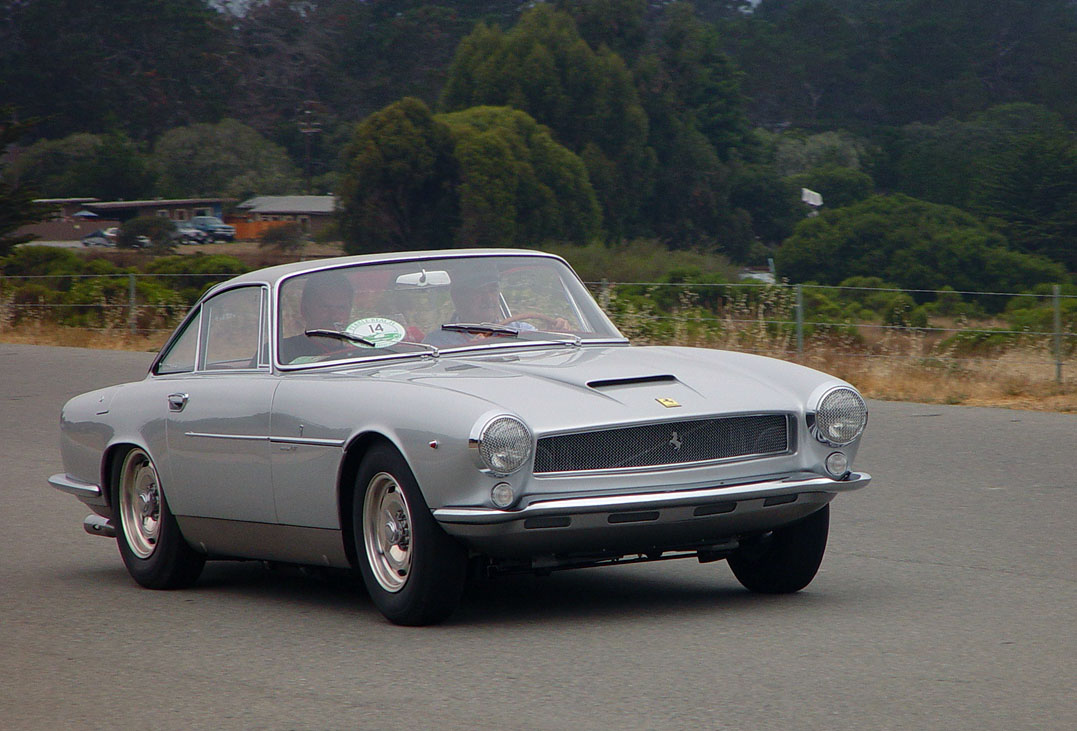
Carrozzeria Alfredo Vignale is the 2026 featured coachbuilder, and in that honor lies an entire lost art. Vignale was born in 1913, the fourth of seven children, and went to work as a panel beater — a shaper of metal by hand and hammer — at the age of eleven. He apprenticed with Pinin Farina and Stabilimenti Farina before opening his own carrozzeria in 1948. The defining moment came two years later, when he began his celebrated partnership with the designer Giovanni Michelotti. Michelotti drew the shapes; Vignale beat them into being. Together they produced a seemingly endless stream of Ferrari, Lancia, FIAT 8V, and Maserati bodies, each one a distillation of what the Italians call, without embarrassment, the golden touch.
Stand before a Vignale Ferrari and you understand why craftsmanship is the only honest word for it. There were no computers, no wind tunnels of consequence, no stamping presses to enforce a form. There was a wooden buck, a sheet of aluminum, a leather sandbag, and a man with a hammer and an eye. The compound curve of a haunch, the taut line running from headlight to tail, the way a grille breathes — all of it was coaxed from flat metal by hand, panel by panel, until the shape in the coachbuilder’s mind became a shape you could touch. These cars are the coachbuilt embodiment of 1950s la dolce vita: sleek, smart, and breathtaking, and today they are regarded as a quintessential distillation of exquisite Italian metal shaping. They are, quite simply, sculpture that happens to have an engine.
The genius of the Concours has always been to place such objects in dialogue, and the 2026 classes read like chapters in the history of automotive beauty. There is a class for early American speedsters — those bare-boned, pre-war machines with names that still ring like poetry, the Stutz Bearcat and the Mercer Raceabout, all cylindrical fuel tank and vestigial fender, stripped to the pure idea of speed. There is a celebration of the streamliner, that short-lived and extravagant moment in the late 1930s when the new science of aerodynamics met the spirit of a Flash Gordon future, and coachbuilders drew teardrop forms so audacious they still look like tomorrow. There is a tribute to the road-racing greats who once thundered through these very forests, when Phil Hill and Carroll Shelby and Ken Miles were young and the course wound perilously between the cypress. And there is a nod to the modern era — Japanese motorsport and its improbable conquests at Le Mans, from Mazda’s rotary victory to Toyota’s long reign.
What unites them across a century of design is not horsepower but intention — the conviction that a machine can carry meaning, that line and proportion and surface are worth laboring over, that beauty is not a byproduct but a purpose. The Concours does not simply reward the fastest or the rarest. Its judges, famously, examine the underside of an engine and the stitch of a seat, and its highest honor, Best of Show, goes to the automobile that most completely fulfills the ideal of the coachbuilder’s art. It is a standard that has quietly shaped how the world thinks about collecting, about preservation, about the automobile as heritage rather than mere transport.
Seventy-five years on, the ritual endures because the questions it asks are timeless ones. What do we choose to save? What do we call beautiful, and why? The men who beat these bodies into being are nearly all gone now — Vignale himself died in 1969 — but their hands remain, legible in every curve, and once a year the tide of the world’s most remarkable automobiles returns to this stretch of coast to be read again.
Come that August morning, when the fog withdraws and the light finds the fairway, look past the crowds to the cars themselves, resting on the grass at the edge of the Pacific. They are not waiting to be driven. They are waiting, as all great art waits, to be seen.