By Eleanor Whitfield
Late on a summer afternoon, when the fog has begun its slow retreat from the pines and the light on Lincoln Street turns the color of honey, a small procession makes its way toward the corner of Seventh Avenue. There is a spaniel with sand still clinging to its ears, a pair of terriers straining happily at their leashes, a poodle stepping high as if it knows exactly where it is going. And it does. This is the hour the regulars call Yappy Hour, and the Cypress Inn is where they are all headed.
To watch it is to understand something essential about Carmel-by-the-Sea, a village that has come to be known, without irony or exaggeration, as one of the most dog-loving towns in America. That reputation did not arrive by accident. It was, in large part, the gift of one woman who believed that the animals we love belong beside us, not waiting in the car.
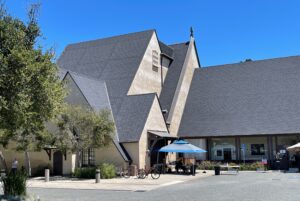
Doris Day was already a celebrated performer when she turned her attention to a modest Spanish Colonial inn in the heart of the village. The Cypress Inn had stood on its corner since 1929, an old building with decorative tilework on its front steps and a gracious living room that gathered locals as easily as travelers. When Day joined her longtime friend and business partner Denny LeVett to purchase it in the mid-1980s, she brought a single non-negotiable condition to the arrangement: four-legged guests would be as welcome as their two-legged companions.
It was, at the time, a genuinely unusual idea. Long before pet-friendly hospitality became something hotels advertised on their websites, Day insisted that a dog checking in should be treated as a guest in full. That conviction transformed the Cypress Inn and, in time, transformed the town around it. The hotel has since been named the pet-friendliest in the nation by more publications than anyone bothers to count. CNN Travel called it a legendary overnight oasis; Sunset dubbed it, simply, the most famous dog-friendly hotel in the country.
Walk through its doors today and the philosophy is immediately, warmly evident. Dogs settle on the patio to sample treats from the restaurant’s own menu. An outdoor, dog-sized shower waits to rinse the beach from a happy coat. Rooms come appointed with blankets and bowls sized for their smallest occupants. “We literally treat them like regular guests,” general manager Peter Radler has said of the approach. “We just like the true, honest companionship of your pet.” He describes something he has watched unfold countless times in the living room and at the bar: strangers falling into conversation over one another’s dogs, friendships forged in the space of an evening. “It’s beautiful to see.”
That bar carries a name worth pausing over. Terry’s Lounge honors Day’s only child, Terry Melcher, the musician and record producer who helped shape the sound of California rock in the 1960s before his death in 2004. His memory lives on the walls there, in artifacts from a life spent in music, and in the easy conviviality of the room itself, where weekly regulars still fill the evenings with live song. It is a mother’s tribute rendered not in marble but in warmth, in a gathering place where people and their companions feel at home. There is something fitting in that. Day spent her later years quietly, at her home in Carmel Valley, tending to the causes that mattered most to her, and the inn she loved became a kind of living portrait of her values.
Chief among those values was the welfare of animals, a devotion that predated any fashion for it by decades. Through the Doris Day Animal Foundation, she built one of the country’s respected grant-giving organizations, funding nonprofits that share her mission of helping animals and the people who love them. The Doris Day Animal League, now part of the Humane Society of the United States, carried her advocacy into the halls where laws are written, and in 1994 established Spay Day, an annual observance still marked across the country. She had a particular tenderness for the overlooked: the senior dogs, the ones others passed by. She spent the last chapter of her life rescuing, healing, and finding homes for them.
Day died in May 2019, at ninety-seven. But a legacy of this kind does not end; it simply passes into the keeping of a community. Each year now, Carmel Beach hosts gatherings that would have delighted her. Poodle Day, trademarked and beloved, unfolds across a full day of celebration: a morning parade through the Carmel Crossroads, an afternoon of play along the sand, and evening cocktail parties at the village’s dog-friendly restaurants, the Cypress Inn among them. Every variety of poodle is welcome, the curly-coated purebreds alongside the labradoodles and goldendoodles who arrive with equal pride. Not long after comes Cavalier Day, when hundreds of Cavalier King Charles Spaniels and their devoted owners take over the beach in what has grown into one of the largest gatherings of the breed anywhere in the world.
These are not marketing inventions. They are the natural expressions of a town that absorbed a lesson and made it its own. Carmel had always been a place of independent character, a village of cottages and courtyards where life is lived at a gentler pace. Day’s insistence that dogs belong in that life, on the patios and in the lobbies and along the white curve of the beach, gave the town a defining piece of its personality. Visitors now arrive expecting it. Many have been returning for thirty years, some asking each time for the same room, their dogs trotting the familiar route to the front steps as though coming home.
There is a photograph in the mind, easily conjured, of the way it must have been in those early years: a woman who had known every kind of fame choosing, in the end, to be known for kindness. She did not lecture the village into loving its dogs. She simply opened a door, held it wide, and let the rest follow. On any given afternoon, when the fog lifts and the light goes gold and the small procession makes its way toward Seventh Avenue, the door is still open. That, more than any accolade, is the measure of what she left behind.