By Eleanor Whitfield
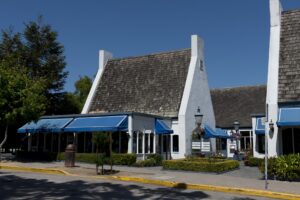
On a weekday just before noon, the corner of Lincoln and Eighth in Carmel-by-the-Sea smells like lunch. Inside Diment Hall, tables are set for nearly a hundred; in the café, someone has claimed the good chair by the window with a library book and a cup of coffee. Down the hall, a watercolor class is rinsing brushes while a yoga session begins in the wellness studio. It could be a small college, or a very good club. It is, in fact, one of the quietest and most complete answers any American town has ever given to a simple question: what do we owe our neighbors as they grow older?
Carmel has been answering that question for seventy-five years.
A postwar promise
In the late 1940s, a group of Carmel residents began to worry about the village’s “old timers” — longtime neighbors living alone, managing on thin means in a town that was already becoming famous for its charm and its visitors. Rather than wait for someone else to act, they organized. In April 1950, The Carmel Foundation was established, and its founders gave their new organization a phrase to live by: this would be “an adventure in neighborliness.”
The words have aged remarkably well. Among those founders was Mrs. Sidney Trevvett, who would serve as the Foundation’s honorary president, and the young organization soon had its first executive director in Mrs. Ruth Sarett. From the beginning, the model was distinctive: this was not charity administered from a distance, but a membership community — neighbors gathering, learning, and looking after one another in the middle of the village.
Just as distinctive is what the Foundation has never done. In seventy-five years, it has never accepted government funding. Its annual operating budget of roughly $2.5 million is sustained by program fees, membership dues, and more than $1.8 million raised each year from the community it serves — a village, in effect, endowing its own old age.
Housing hidden in plain sight
The Foundation’s most remarkable work may be the one most visitors never see. In 1962, the organization purchased a small apartment building and launched a low-income housing program — an almost audacious undertaking for a village nonprofit. Two years later it acquired a former hotel, which became Trevvett Court, carrying a founder’s name forward. Haseltine Court followed in 1965, and in 1988 came the construction of Norton Court. A 2009 remodel of Trevvett Court expanded it from nine units to fourteen.
Today, The Carmel Foundation offers forty-nine affordable apartments to low- and very-low-income seniors — not on the outskirts of town, but woven into the blocks of one of the most expensive real estate markets in America. In a town celebrated for its second homes, these apartments are first homes, and for many residents, final ones, kept within walking distance of the shops, the beach, and the community that knows their names. It is a model of aging in community that housing experts travel far to study, operating quietly behind cottage facades.
The rhythm of the campus
The Foundation’s campus at Lincoln and Eighth serves more than 2,500 members age 55 and better — a figure that rivals the entire residential population of Carmel-by-the-Sea itself, drawing members from across the Monterey Peninsula. The weekly calendar carries more than fifty classes and activities: painting, woodcarving, languages, bridge, fiber arts, strength and balance.
Some traditions have deepened with time. The homebound meal delivery program began in 1960, bringing healthy meals — and a knock at the door — to neighbors who could no longer come to lunch. The lunch program itself began as a once-a-month potluck; with the building of Diment Hall and its professional kitchen between 1975 and 1981, it became a four-day-a-week dining program where members share an affordable midday meal in good company.
The Foundation has also made a habit of meeting each era on its own terms. In 1995, it opened a Computer Learning Center designed to remove fear and build confidence; within five years, more than a thousand members had graduated from its technology courses. The 2011–12 remodel added the café, open-air dining, and a garden — social spaces built on the understanding that connection is as vital to health as any prescription. And there are the small, telling services that rarely make a brochure: free loans of wheelchairs and walkers, a lending library, blood pressure checks, caregiver support groups, and day trips to museums and performances.
The seventy-fifth year, and the next
The Foundation marked its seventy-fifth anniversary in 2025 the way it has marked every era — by building. In 2023, it acquired the former American Red Cross building at the corner of Dolores and Eighth and began transforming it into a wellness center. By the anniversary year, the doors were open, and last August the Foundation threw them wide for a community open house, with sample classes in yoga and qigong in the new Jill Sheffield Wellness Studio, woodcarving and painting demonstrations, and chess lessons for anyone curious enough to sit down.
It was a fitting celebration: not a gala at arm’s length, but an invitation to come inside — the same invitation the founders extended in 1950.
What the founders could not have known is how thoroughly their adventure would succeed. The organization they built to look after a few dozen old timers now touches thousands of lives a year, without ever losing the domestic scale of its beginnings. Members still come for lunch. Neighbors still deliver meals. The classes still fill.
And on Trevvett Court, the name of a woman who helped start it all still hangs above a doorway — not on a plaque in a lobby, but on a place where fourteen of her neighbors are home.