By Vivienne Calloway
There is a particular hour on the Monterey Peninsula, just before the fog lifts, when the light seems to hold its breath. It moves low across the cypress and the tide pools, silvering everything it touches, and then it is gone. Photographers have chased that light for the better part of a century here, and a good many of them have failed to catch it. The ones who succeeded left us something close to a native art form — the black-and-white print, luminous and exacting, made along this stretch of California coast. To stand in the presence of that tradition, you need only walk into a stone-walled room off San Carlos Street, where it is still being practiced, exhibited, and taught.
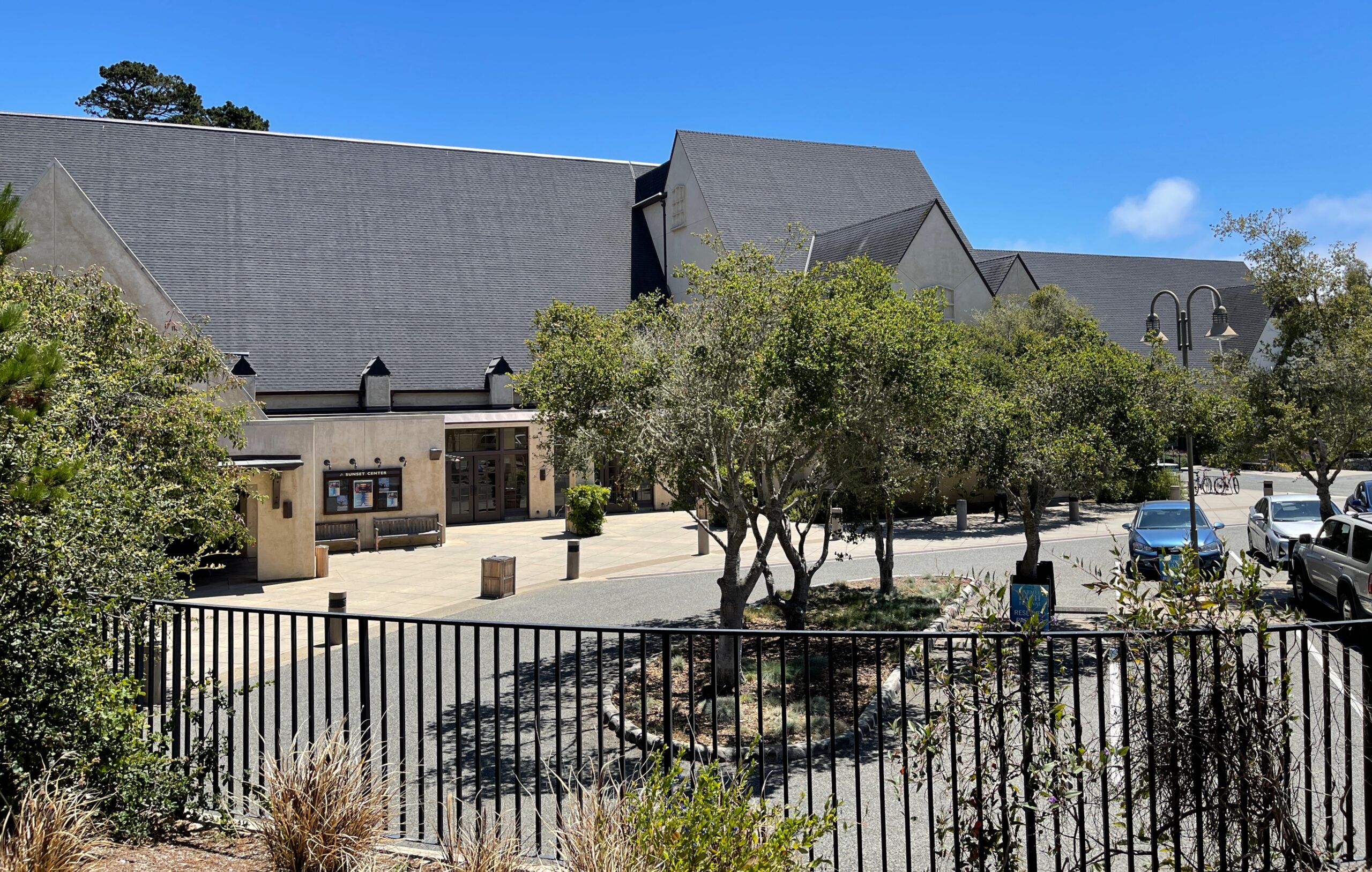
The Center for Photographic Art occupies a quiet wing of the Sunset Center, the former schoolhouse at San Carlos and Ninth that has served as Carmel’s cultural hearth for generations. The gallery is unassuming from the street, as most of the best things in this village are. Inside, the walls are hung with photographs lit like objects of devotion, and the hush is the hush of a place that takes looking seriously. It is one of the oldest members’ photography galleries in the country, and it carries a lineage that would be the envy of any museum.
An inheritance of masters
That lineage begins, as so much of American photography does, with a small aperture and a large ambition. In 1932, a handful of Bay Area photographers — Ansel Adams, Edward Weston and his son Brett, Imogen Cunningham, Willard Van Dyke, and a few others — banded together under the name Group f/64. The name referred to the smallest setting on a large-format lens, the one that renders a scene in merciless, edge-to-edge clarity. It was a manifesto disguised as a technical term. Against the soft, painterly pictorialism then in fashion, these photographers argued for the pure, sharp, unmanipulated image: the world seen whole, the print as an end in itself rather than an imitation of another art.
The Westons made their home on this peninsula, and Edward’s images of Point Lobos kelp, of peppers and nautilus shells, of the dunes at Oceano, remain among the most reproduced photographs ever made. Adams, for his part, would go on to found the Friends of Photography in Carmel in 1967, one of the first organizations in the nation devoted to the medium as a fine art. For two decades the Friends brought exhibitions, workshops, and the company of serious artists to a town already thick with them.
When the Friends of Photography relocated to San Francisco in the late 1980s, the Carmel galleries stood to fall dark. Instead, the local photographic community — led by Roger Fremier, then head of photography at Monterey Peninsula College — took up the lease and, in 1988, founded the Center for Photographic Art to carry the work forward. It was an act of quiet stewardship, the kind Carmel has always managed at its best: not a monument to the past but a working continuation of it. The Center inherited the space, and with it, a responsibility to the light.
Embracing light, this summer
That responsibility is on the walls right now. Through the end of July, the Center presents Embracing Light, a two-person exhibition of the photographers Anne Larsen and John Sexton — partners in life and in art for more than thirty years, and among the most devoted practitioners of the traditional black-and-white print working today.
The pairing is a fitting one for this room. Both photographers work with large- and medium-format film cameras, the patient, tripod-bound instruments that force a photographer to slow down and see. Both make their prints by hand, in a conventional darkroom, on silver gelatin paper — the same fundamental process that Weston and Adams used, coaxing an image up out of a tray of developer in near-total darkness. In an age when most photographs are made and consumed in seconds on a lit screen, there is something almost devotional about this insistence on craftsmanship, on the physical print as the true and final form of the work.
Sexton’s connection to the Peninsula’s photographic heritage runs deeper still. For years he served as photographic assistant and technical consultant to Ansel Adams himself, and his own images — quiet, tonally rich studies of the natural world and the made one — have long been admired for their control of exactly the quality the exhibition names. Larsen’s work shares that reverence for luminosity, for the way light describes a surface and gives it presence. Hung together, their photographs make a subtle argument: that the pursuit Group f/64 began has not been exhausted, that there is still light on this coast worth chasing and craft enough to hold it.
To walk the gallery is to be reminded that a great print rewards the same slow attention it demanded to make. These are not images to glance at. They ask you to stand, to let your eye travel the full range from deepest black to luminous white, to notice how much feeling lives in the grays between.
A working darkroom, still
What distinguishes the Center from a conventional gallery is that it does not merely display this tradition — it perpetuates it. Behind the exhibition rooms is a working darkroom, and around the calendar runs a steady program of workshops, lectures, and artist talks that treat photography as a living discipline rather than a settled history. In recent seasons the Center has hosted printing clinics, portfolio-development intensives, an ongoing history-of-photography lecture series, and conversations with artists working in everything from the nineteenth-century daguerreotype to contemporary documentary work.
Its juried exhibitions draw entries from around the world; a recent members’ show, mounted as part of the Center’s growing PhotoCarmel celebration, was selected from more than two thousand submissions by a curator from the Center for Creative Photography in Tucson, the great archive of Ansel Adams’s own work. The through-line is unmistakable. What was begun on this peninsula in the 1930s is not preserved here under glass. It is handed forward, one print and one workshop at a time.
There is a temptation, in a town as image-conscious as Carmel, to treat photography as decoration — the postcard sunset, the well-composed cypress. The Center for Photographic Art exists to remind us that it is something more demanding and more enduring than that: an art of patience and precision, of standing very still until the light is right, and then of long hours in the dark bringing the picture into being.
Embracing Light remains on view through July 27 at the Center for Photographic Art, Sunset Center, San Carlos Street at Ninth Avenue, Carmel-by-the-Sea. Admission is free, and the gallery welcomes visitors several afternoons each week. It is worth the walk. Somewhere on those walls, if you give it the time, you will find that particular Monterey light — held at last, and still.