By Julian Marsh
There is a moment, walking in from the road at Asilomar, when the Monterey pines part and a low-slung building of stone and timber seems to rise directly out of the dunes — as though it had grown there rather than been built. This is the effect Julia Morgan spent her life perfecting: architecture that does not announce itself, but belongs. Long before the towers of Hearst Castle made her a legend, Morgan was here on the western edge of Pacific Grove, teaching wood and stone to speak the language of the coast.
For fifteen years, from 1913 to 1928, she returned to this windswept ground at the tip of the Monterey Peninsula and built a village of restraint. Today the Asilomar Conference Grounds hold one of the finest concentrations of her work anywhere — and one of the most quietly moving. It is a place that rewards the patient eye.
A refuge by the sea
The story begins with a name. When the Young Women’s Christian Association set out to create a western retreat, Phoebe Apperson Hearst — the philanthropist and mother of William Randolph Hearst — championed the cause, opening her own estate to the YWCA’s leadership conference in 1912 after fire destroyed their intended hotel. A naming contest followed, won by a Stanford student named Helen Salisbury, who joined two Spanish words, asilo and mar, into a single graceful idea: Asilomar, “refuge by the sea.”
It was Hearst who recommended the architect. Morgan, by then, was a woman of firsts. She had been the first woman admitted to study architecture at the École des Beaux-Arts in Paris, and in 1904 became the first woman licensed to practice architecture in California. Over a prolific career she would design more than seven hundred buildings. But Asilomar was something apart — a commission she nurtured across a decade and a half, returning again and again to refine a single, coherent vision.
Reading the buildings
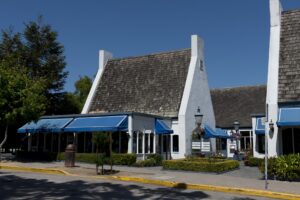
Morgan built in what architectural historians call the First Bay Tradition, the Northern California expression of the Arts-and-Crafts movement. Its creed was honesty: honest materials, honestly joined, in harmony with the land. At Asilomar she followed it to the letter. Nearly every building rose from local stone and redwood — split-wood shingles weathering silver in the salt air, exposed timber structure left plainly visible, foundations of native granite battered gently outward as if bracing against the wind.
The vocabulary repeats from building to building like a well-loved refrain. Low-pitched roofs. Deep projecting eaves that throw cool shadow. Grouped casement windows that gather the pale coastal light and lay it across wooden floors. Porches that mediate between shelter and the open dunes. Nothing is ornamental for its own sake; every gesture serves the whole.
Construction began in the spring of 1913, and by that August the Social Hall and the first Longhouses stood ready, welcoming three hundred young women to the inaugural summer program. The Social Hall remains a marvel of the carpenter’s art — a great room where redwood trusses arch overhead and a massive stone fireplace anchors the space, the kind of room that makes a gathering feel like an occasion.
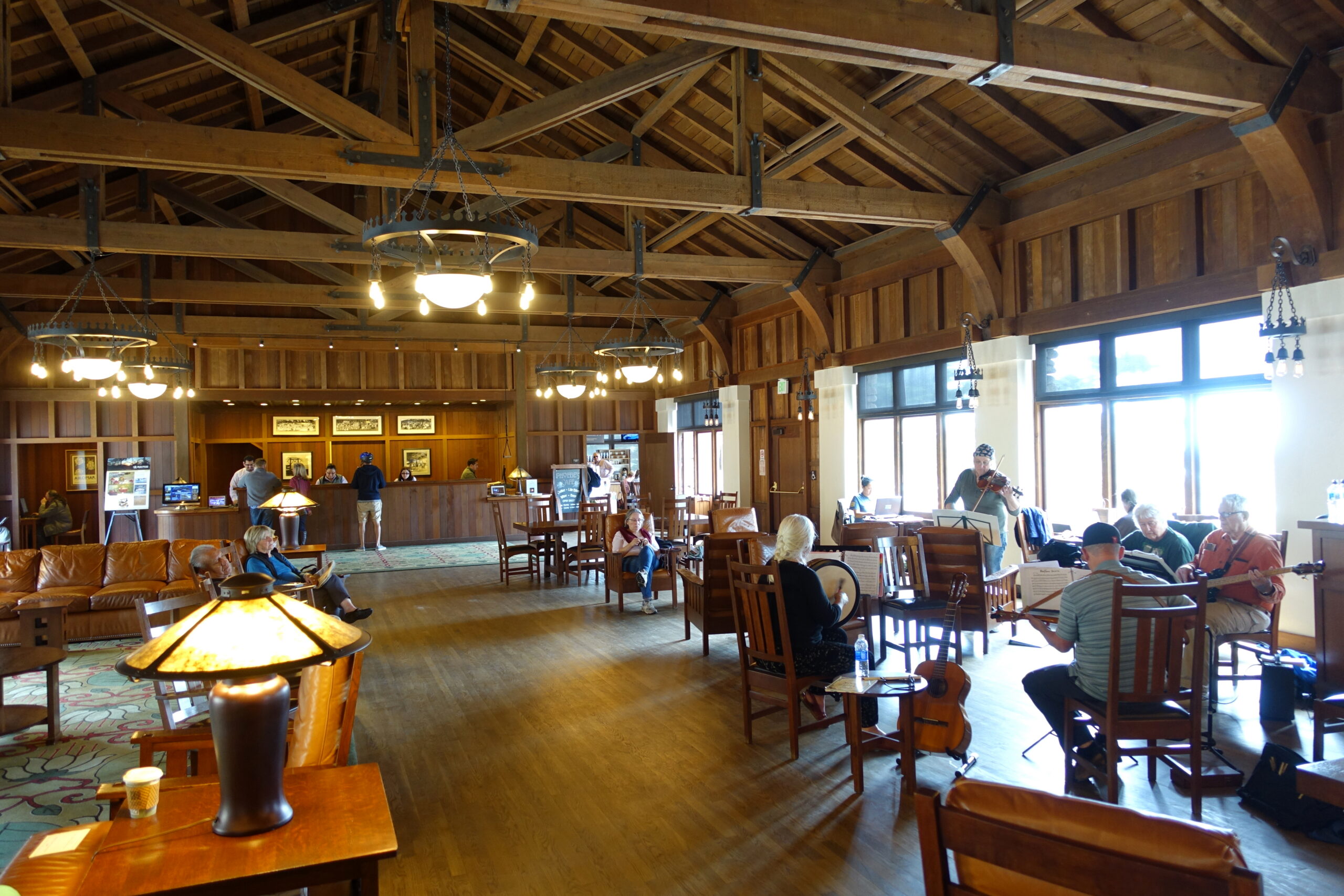
Morgan’s final building here, Merrill Hall, was dedicated in 1928 and stands as the culmination of everything she had learned on this ground. Set on a slight rise, it might have loomed; instead, through her disciplined use of native stone and wood, it settles into the landscape as gracefully as its humbler siblings. Inside, the exposed structure becomes the decoration — beams and braces composed with the care a jeweler brings to a setting.
In all, Morgan designed more than twenty-five structures at Asilomar over those fifteen years, from the grand halls down to the garages and utility buildings, each held to the same standard. Eleven of them survive today, and many still serve the very purposes for which she imagined them — a rare continuity in a restless age.
Craft as conviction
What lingers, standing among these buildings, is the sense of a mind entirely at ease with its materials. Morgan trained first as an engineer at the University of California before Paris refined her eye, and that dual fluency shows everywhere at Asilomar — in structure that is never hidden because it never needed to be. The timber is the ornament. She understood, as the finest Arts-and-Crafts makers did, that a building could be a moral statement: that beauty and integrity were the same thing seen from different angles.
There is a restraint here that reads, a century on, as generosity. Morgan built for young women of modest means come to learn and gather by the sea, and she gave them not grandeur but grace — rooms full of light, warmed by fire and native wood, opening onto the dunes and the surf beyond. The luxury was never in the material. It was in the care.
A landmark, still living
In 1987 the Asilomar Conference Grounds were designated a National Historic Landmark — honored for its role in the history of women’s recreation, in the growth of the YWCA, and in the resort heritage of the Monterey coast. The 107-acre site is now managed by California State Parks as Asilomar State Beach and Conference Grounds, and it remains, remarkably, open to all.
This is the quiet gift of Asilomar. Unlike the ticketed pilgrimage to Hearst Castle, Morgan’s masterwork by the sea can simply be walked into. Guests still lodge in her buildings; day visitors may wander the grounds, step into the Social Hall, follow the boardwalk that threads the restored dunes to the shore. The wood has silvered further, the stone has settled deeper, and the buildings look more than ever like something the coast produced on its own.
Julia Morgan rarely spoke about her work, preferring the buildings to make her case. At Asilomar they still do. Come at the end of an afternoon, when the light goes long and gold across the timber and the fog begins to gather offshore, and you will understand what she was after all along — an architecture of belonging, timeless and unhurried, built to weather every season the Pacific could send.
She gave the coast a refuge worthy of its name.