By Julian Marsh
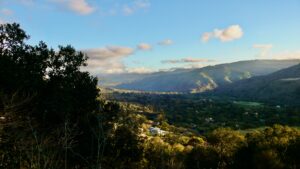
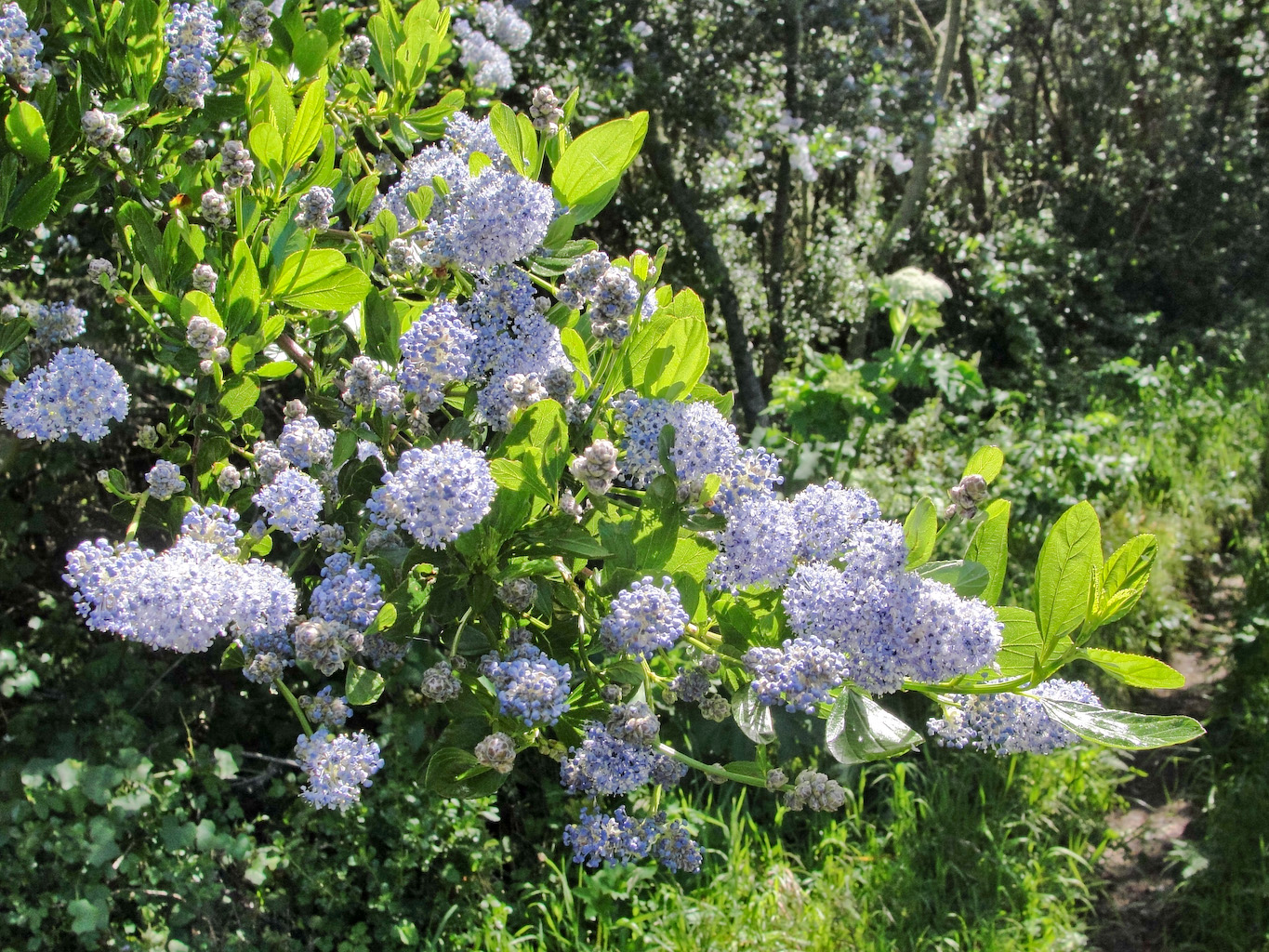
A few minutes’ walk from the shops of Ocean Avenue, down a wooded canyon that most visitors never find, Carmel keeps a garden that refuses to behave like one. There are no clipped hedges here, no imported roses, no lawn. Instead: manzanita holding its smooth red limbs against the fog, ceanothus and sage, buckwheat and bunchgrass — better than a hundred species of native California plants, each labeled in the patient hand of volunteers, arranged across a single sunlit acre inside the Mission Trail Nature Preserve. From its upper reaches, on a clear day, the view slips over the treetops to the Pacific and the dark profile of Point Lobos to the south.
It is called the Lester Rowntree Native Plant Garden, and to understand why an acre of unruly wildflowers ranks among the most quietly moving places in the village, you have to know the woman it honors — one of the most remarkable Californians of her century, who happened, for most of her hundred years, to call this coast home.
The Lady-Gypsy of the Carmel Highlands
Lester Gertrude Ellen Rowntree was born in Penrith, England, on the edge of the Lake District, in 1879, and came to America with her family as a child in 1887. The outline of her early life was conventional enough — marriage, a son, a household. Then, in the early 1930s, past the age of fifty, a divorce left her with almost nothing in Carmel. It is the sort of moment that ends most stories. It is where hers begins.
Rowntree rebuilt her life around a single, unfashionable obsession: the native flora of California. She was entirely self-taught — no degree, no institution, no patron — and she turned that independence into a method. “I didn’t take this up for the poetry of it,” she wrote. “I honestly wanted to find out about California wildflowers. There was little written about them in their habitats and nothing at all about their behavior in the garden, so I made it my job to discover the facts for myself.”
Discovering the facts meant going to the plants. For roughly half of every year, Rowntree loaded her car with camping supplies, hiking gear, a camera, and seed bags, and disappeared into the state — deserts in spring, the high Sierra in summer, following the bloom up the mountains as the season climbed. She slept outdoors, hiked alone into her seventies and beyond, and described herself, cheerfully, as a “lady-gypsy.” The automobile was never the point. “My car is purely a means of transportation to the vicinity of these places,” she wrote. “No one who has not left the highway and followed out-of-the-way trails can have any conception of the poignant beauty of the haunts of California wildflowers.”
The winters she spent in the Carmel Highlands, in a house above the ocean bought entirely with her earnings from writing about plants — a detail she relished. From that perch she built a national reputation seed packet by seed packet and page by page: a seed business that shipped wild California to gardeners across the world, a hand in founding the California Horticultural Society, more than seven hundred published articles, and two books, most enduringly Hardy Californians of 1936, a field guide braided with memoir that has never lost its readership.
She was also, when the occasion demanded, a botanical outlaw. When San Francisco moved to sell off cemetery land where one of the last wild Franciscan manzanitas grew — a shrub rare then and endangered still — Rowntree lobbied the city to save it and was ignored. So she went in at night, crawled among the gravestones, dug out the specimen, and spirited it home to the Highlands. She confessed the crime herself in Hardy Californians, reporting that she had “garnered it ghoulishly in a gunnysack.” Conservation, in her hands, was not a committee. It was a shovel and a dark night.
Lester Rowntree died in 1979, in her hundredth year, having outlived nearly everyone who ever doubted that a self-taught woman past fifty could remake American horticulture from a cottage in the Carmel Highlands.
The Garden in the Canyon
The preserve that shelters her garden is itself a small miracle of restraint. Mission Trail Nature Preserve occupies thirty-four acres in the southeastern corner of the village — a wooded canyon carved by a seasonal tributary of the Carmel River, half a mile from the sea, threaded with three miles of trails and five trailheads. The city acquired the land in the early 1970s and designated it a nature preserve for quiet, passive use in 1979 — the year of Rowntree’s death — and it has resisted improvement ever since. Within its borders grow five distinct habitats, from wet meadow and willow-lined riparian forest to coastal terrace prairie, including the last naturally occurring stands of Monterey pine and coast live oak forest remaining in Carmel.
The Rowntree garden is the preserve’s composed heart. Here the wild abundance she chased across the state is gathered into a single teachable acre: over one hundred native species, each identified with a label, so that the visitor learns to greet by name plants they have walked past all their lives. The work of keeping it — weeding, propagating, replanting, mending paths — belongs to volunteers, notably the Friends of Mission Trail Nature Preserve, a nonprofit of devoted residents recognized by the city as the preserve’s official support group. The preserve’s master plan, adopted into the city’s General Plan, devotes a special section to the garden; the Friends devote their Saturdays to it. It is stewardship in the most Rowntree-like register imaginable: unpaid, unglamorous, and utterly faithful.
There is design here, though it announces itself softly. The garden’s craft lies in editing rather than imposing — in the placement of a path so that the manzanita’s sculptural branches catch the morning light, in the pairing of gray-green sages with the rust of buckwheat gone to seed, in the long view held open toward Point Lobos. It is gardening as Rowntree preached it: the gardener as student of the landscape, never its conqueror. Hummingbirds work the salvias; chickadees and juncos move through the pines. In high summer, when the coastal fog burns off by midday, the acre hums.
An Hour Well Spent
The garden is open, like the preserve around it, from dawn to dusk every day of the year, and it asks nothing of the visitor but attention. (Dogs, welcome on the preserve’s trails, must sit this one out — the garden itself is theirs to admire from the gate.) Come in the morning with Hardy Californians in hand, if you can find a copy; the University of California Press reissued it, and it reads as freshly as it did ninety years ago.
Then climb to the garden’s upper edge and look south. The Pacific glitters beyond the pines, and Point Lobos lies dark against the water — the same prospect, more or less, that greeted a fifty-two-year-old woman with no money, no institution behind her, and a car full of seed bags, who looked at wild California and decided it deserved a biographer. One acre is not much land. It is exactly enough for a legacy.
The Lester Rowntree Native Plant Garden lies within Mission Trail Nature Preserve, reachable from trailheads including Rio Road opposite the Carmel Mission and Mountain View Avenue. Open dawn to dusk daily. To volunteer or support the garden’s care, visit the Friends of Mission Trail Nature Preserve at friendsofmissiontrail.org.