By Graham Ashford
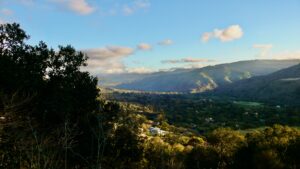
Come at the end of the day, when the light does its best work. Turn off Rio Road below the Carmel Mission, follow Dolores Street a few hundred yards past where the village seems to end, and there it is: a white farmhouse, a scatter of barns and cottages under old cypress and eucalyptus, and a meadow running down toward the wetlands of the Carmel River, where sheep graze against a backdrop of Point Lobos and the open Pacific. Somewhere behind you, a piano has started up. You have arrived at Mission Ranch, and your first instinct will be the correct one: this cannot possibly still exist.
It very nearly didn’t. But that story comes later, because Mission Ranch has never been in a hurry, and neither should you be.
A hundred and seventy years of luck
The ranch’s own telling of its history begins with Juan Romero, a Native American man believed to have lived in the village beside the Carmel Mission, who owned the 160 acres surrounding it. In 1852 he deeded the land to William Curtis, a Monterey storekeeper, for three hundred dollars — and in the years that followed, the property became one of the first of California’s early dairies. The creamery that supplied Monterey County with cheese and butter still stands; it houses the restaurant today, which means that when you order dinner at Mission Ranch you are eating in a building that has been in the nourishment business for the better part of two centuries. The Martin family, who held the ranch for sixty years, worked the dairy and farmed potatoes for the Sierra gold miners — Carmel’s pastures feeding the Gold Rush, a detail almost too good to be true.
Some seventeen owners have had their turn at the property, and the twentieth century gave it a livelier chapter or two. The ranch operated as a private club, and then, during the Second World War, as an officers’ club for the Army and Navy — an era when the windows were occasionally blackened against the possibility of a Japanese landing, even as dance bands played inside. Under the Dienelt family, who kept the ranch for thirty-nine years, it earned what the inn’s own history cheerfully calls a rollicking reputation: a lively bar, music, the village letting its hair down at the edge of the pasture. Pieces of the land were sold off along the way — to the school district, to the state — and by the mid-1980s the remainder was headed toward the fate that has claimed so much of coastal California: the ranch was slated to become a condominium development.
The neighbor who said no
This is where Clint Eastwood enters the story, and it is worth being precise about the role he plays in it. He is not the founder of Mission Ranch, nor its inventor; he is its steward — a local who had known the place since his Army days at Fort Ord in the early 1950s, when the ranch’s bar was where a young soldier went to feel human again. In 1986, when the bulldozers were all but scheduled, he bought the property and stopped them.
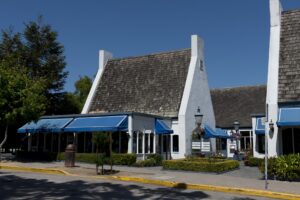
What he did next matters more than the purchase. Rather than gild the ranch into something it had never been, he restored it into a finer version of exactly what it was. The inn’s history records that he sought out the best craftsmen available and had them replicate the moldings, doorframes, and hardware of the original buildings — restoration as an act of fidelity rather than fantasy. Each structure kept its era: the restaurant and dance barn their 1840s farmstead character, the century-old Martin farmhouse its Victorian propriety, the Bunkhouse — the oldest structure on the ranch — its plainspoken charm. The result is thirty-one rooms scattered across the property’s historic buildings, no two alike: rooms in the Main Barn and the Hayloft, the Honeymoon Cottage, the Farmhouse, Meadowview rooms facing the sheep pasture and the sea beyond. There is no lobby to speak of, no spa menu, no procession of amenities. There is a farmhouse porch, a rope hammock’s worth of quiet, and that view.
The piano bar test
But lodging is only half of what Mission Ranch is. The other half reveals itself after dark, in the restaurant that occupies the old creamery, where something increasingly rare in resort-country California still happens nightly: locals.
The piano bar at Mission Ranch is, by broad village consensus, Carmel’s living room. The piano starts in the early evening and the room gathers around it — residents who have been coming for decades, ranch guests down from the Farmhouse, celebrants of every kind — and by the second hour the singing has generally become communal. The kitchen’s virtues are of the unimprovable American kind, prime rib chief among them, and the smart order is a table on the heated patio, where dinner comes with the meadow, the sheep, and the sun dropping behind Point Lobos. The sheep, it should be said, are residents, not livestock in any working sense — the ranch keeps them as mascots on the last stretch of open pasture, a living reminder of the dairy years. They are, collectively, the best-situated flock in California, and they seem to know it.
It is here, somewhere between the piano and the pasture, that you understand what was actually saved in 1986. Not merely ten old buildings, though the buildings are lovely. What was saved was a kind of continuity — a place where Carmel’s ranching past, its rollicking mid-century, and its refined present all occupy the same few acres, on speaking terms with one another. Condominiums would have been profitable. This is irreplaceable.
Grace notes
The room: Ask for a Meadowview room or the Farmhouse if the occasion is special; the Bunkhouse, the ranch’s oldest building, suits travelers who like their history close.
The table: Book the restaurant’s patio for an hour before sunset, and stay for the piano bar afterward — the evening’s true second act.
The season: Fall brings the clearest evenings over Point Lobos, but the piano plays year-round, and the fog gives summer nights their own gray-flannel romance.
The walk: The path from the ranch through the Carmel River wetlands to the beach takes fifteen minutes and improves every appetite. The sheep will watch you go.