By Graham Ashford
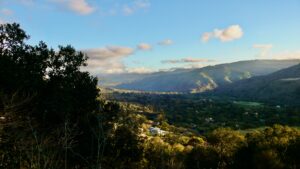
You do not see Post Ranch Inn from Highway 1. That is the first thing to understand about it, and in a sense the only thing: twelve hundred feet above the Pacific, on a ridge where the Post family once ran cattle, sits one of the most celebrated hotels in the world, and from the most scenic road in America it is all but invisible. Sod roofs disappear into the meadow grass. Weathered redwood recedes into the forest. Guest rooms on stilts stand among the trees like part of the canopy. The greatest luxury hotel on the California coast was designed, from its first sketch, to vanish.
The man who drew those sketches was Mickey Muennig, and the story of Post Ranch is inseparable from his. Born George Kaye Muennig in Joplin, Missouri, in 1935 — the nickname came from an older sister who thought he resembled Mickey Mouse — he studied architecture at the University of Oklahoma under Bruce Goff, the great apostle of organic design. In 1971 he arrived in Big Sur, intending to stay briefly. He stayed fifty years, living for a time in a glass teepee of his own design, and built so much of the coast’s most distinctive architecture that he became known, simply, as the man who built Big Sur. When he died in June 2021, at eighty-six, the coast lost its defining architect. Post Ranch remains his masterwork — the fullest statement of his conviction that a building should grow from its site rather than land upon it.
Ranch first, inn second
The land came with its own century of stories. William Brainard Post homesteaded this stretch of coast in the 1860s, and generations of the Post family ranched the ridge above what is now the highway. When the inn opened in April 1992 — the first new hotel in Big Sur in seventeen years — it took the family’s name and, more unusually, honored the family’s landscape. Nothing about the original thirty rooms asserted itself against the ridge. Muennig shaped his buildings around the land’s existing facts: where a stand of redwoods stood, he built among them; where the meadow rolled open toward the cliff edge, he tucked the rooms into the earth itself.
The result is a vocabulary of structures that still, three decades on, has no real imitators. The Ocean Houses burrow into the ridge under roofs of sod and wildflowers, so that a guest approaching from above sees only meadow — and then steps inside to a curved room facing an uninterrupted horizon of water. The Tree Houses stand on slender stilts ten feet off the forest floor, a solution born of practicality (the stilts protect sensitive root systems and let the buildings ride out seismic movement) that reads as pure poetry. The Butterfly Rooms take their geometry from spread wings; other structures nod, in their towers and cylinders, to Goff’s exuberant influence. Today there are thirty-nine rooms and a pair of private houses, and no two are quite alike, because no two pieces of the ridge are quite alike.
Muennig’s rooms refuse, gently, most of the vocabulary of luxury. There is no marble lobby, no chandelier, no grand porte-cochère. There are, instead, walls of glass aimed at the sea or the Santa Lucias, wood-burning fireplaces, deep tubs positioned for the view, and a silence so complete it takes a day to fully hear. The luxury is the twelve hundred feet of air between your window and the whales passing below.

The measure of the thing
The world’s arbiters have, in their way, caught up with what Muennig understood in 1992. When the Michelin Guide introduced its hotel Keys, Post Ranch Inn received the rarest tier — Three Keys, a distinction it has now held for consecutive years as one of only sixteen hotels in the United States so honored, and the only one in Monterey County. Sierra Mar, the glass-walled restaurant Muennig cantilevered toward the cliff edge, remains among the most extraordinary dining rooms anywhere: a prix fixe dinner suspended between mountain and ocean, timed, if you are wise, to the sunset.
But the honors rather miss the point, which is that Post Ranch proposes an argument about what luxury is. Most grand hotels are built to be seen — to announce arrival, to photograph well from the drive. Post Ranch is built to see from. Every design decision subordinates the building to the view, the object to the experience. Guests wake under a living roof, walk meadow paths past the same grasses the Post cattle grazed, and find that after a day or two the nervous system recalibrates to the ridge’s own rhythms: fog in, fog out, condors overhead, the slow wheel of stars unpolluted by any city’s glow.
This is why the inn has aged so gracefully while flashier contemporaries date themselves within a decade. A building that defers to a landscape borrows that landscape’s timelessness. The Santa Lucias do not go out of style.
Going now
There has rarely been a better season to make the pilgrimage. With Highway 1 fully reopened — the last closure at Regent’s Slide cleared in January 2026, after Caltrans anchored the hillside with more than 4,600 steel bars — Big Sur is whole again for the first time in nearly three years, and the drive to the inn’s discreet gate, thirty miles south of Carmel, is once more part of the experience rather than an exercise in detour arithmetic.
Be forewarned that disappearing does not come inexpensively: Post Ranch operates in the upper reaches of American hotel rates, adults only, with rooms booked far ahead for summer and fall. But among the world’s great hotels it may be the one whose price buys the least ostentation and the most transformation. You arrive, the buildings recede, and what remains is the oldest luxury on this coast — the coast itself.
Muennig once said his ambition was architecture that touched the earth lightly. Thirty-four years on, his ridge-top masterpiece still holds that pose: a hotel so at home in its landscape that the landscape appears, at first glance, to be all there is. That is not an absence of design. It is design’s highest achievement — the art of building something unforgettable by making it almost impossible to see.