By Vivienne Calloway
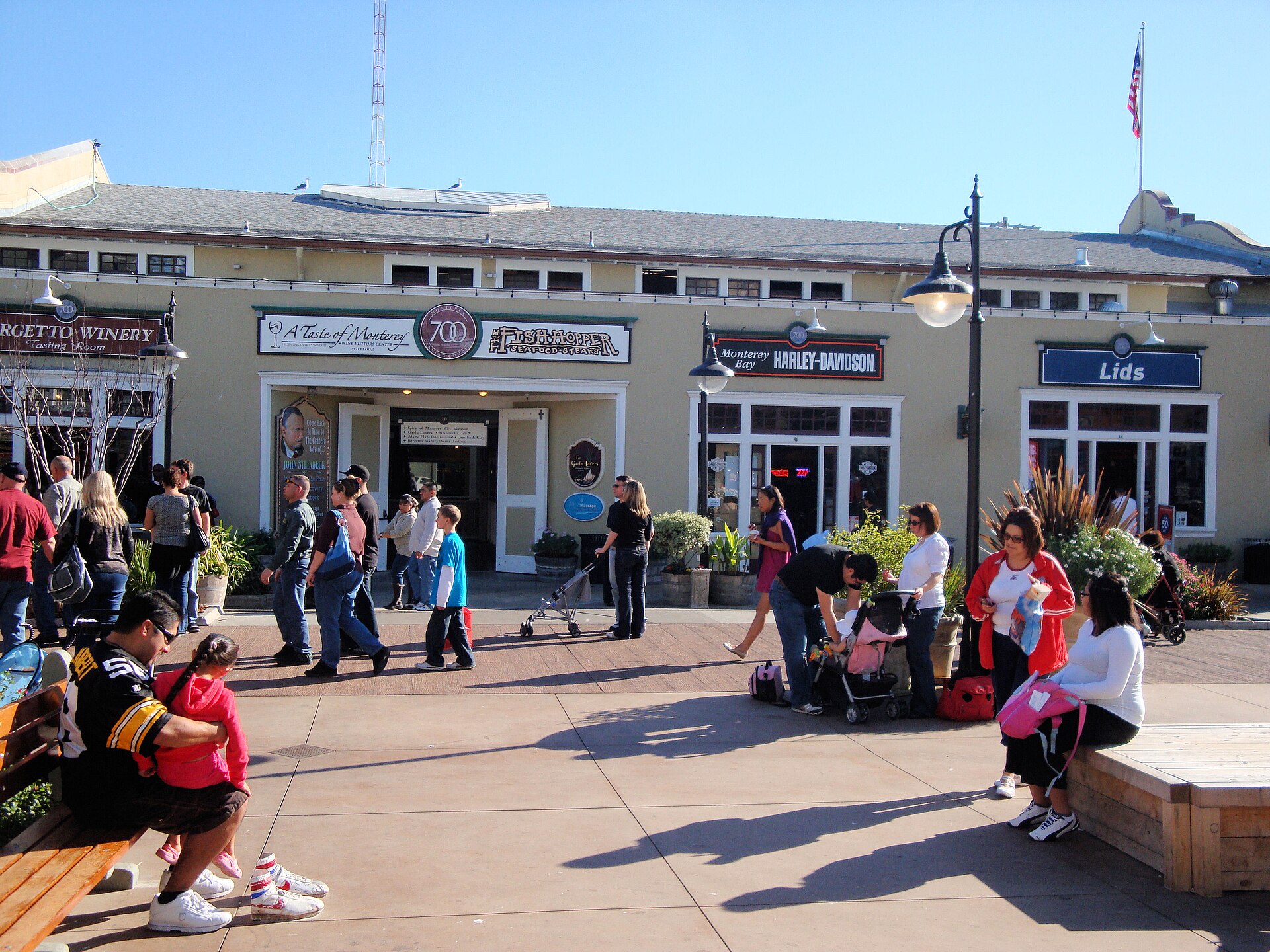
At the western end of Cannery Row, where Steinbeck Plaza opens toward the water, nine bronze figures gather on a cascade of sculpted rock. At the summit sits John Steinbeck himself, jacket rumpled, gazing down the street he made immortal. Below him, the marine biologist Ed Ricketts — Steinbeck’s great friend, and the model for Doc in Cannery Row — contemplates a sea star as if the tide pool had just surrendered it. A Chinese fisherman stands for the village that worked this shore in the 1850s; two women recall “Madam” Flora Woods, the Row’s famously generous keeper of the Lone Star Café, and one of her girls; and four men at their ease together represent “the boys” — cast, in a graceful turn, from the four entrepreneurs who rescued the Row from ruin. Hidden throughout, for children and the incurably curious, are thirteen small bronze frogs, a wink at the frog hunt that animates Steinbeck’s novel.
The Cannery Row Monument — fifteen feet high, seventeen feet wide, dedicated on February 26, 2014 — has become the most photographed, most climbed-upon, most beloved piece of public art on the Monterey Peninsula. What many of the visitors posing beside Ricketts do not know is that every one of those figures began as clay in a studio in Carmel, under the hands of a British-born sculptor named Steven Whyte — and that the studio door is open, most days, to anyone who cares to watch the next monument take shape.
The Classicist in the Village
Whyte’s path to Carmel runs through the most rigorous classical training the old world could offer. Born in England in 1969, he was schooled in the traditional methodology of figurative bronze and portrait sculpture at a time when much of formal art education had drifted away from the figure altogether. He was still an undergraduate when the commissions began arriving — bishops, viscounts, captains of industry, the Speaker of the House of Commons — and he became the youngest member of the London-based Society of Portrait Sculptors, an institution he would later serve as vice president. Troubled by the decline of figurative teaching in Britain, he co-created the first nationally validated course devoted to figurative sculpture and taught it himself, helping keep a candle lit for a tradition that stretches back through Rodin to the Renaissance.
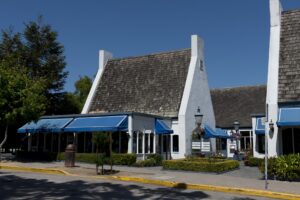
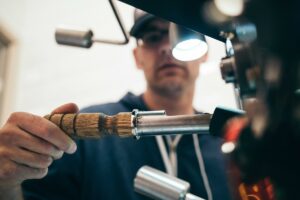
In 2004, Whyte crossed an ocean and a continent and settled in Carmel — a decision that, in hindsight, has the ring of inevitability. This is, after all, the town that organized itself around working artists a century ago, where the Carmel Art Association’s founders built their own gallery and the sculptor Jo Mora carved his monuments a few miles from the Mission. Whyte opened Steven Whyte Sculpture Studios and Gallery and did something quietly radical in an art market of finished, well-lit objects: he made the process itself the exhibition. At his working studio in The Barnyard, south of the village proper, visitors wander in among armatures and clay to find monuments in embryo — a head emerging from a maquette, a full figure awaiting its molds. Whyte is usually there, tools in hand, happy to explain what a thumb can do that no instrument can.
The résumé that has accumulated around that studio is formidable. Whyte has produced more than fifty life-size and larger bronze figures for public installations in England and across the United States — miners, soldiers, firefighters, statesmen. His sixteen-figure National Salute to Bob Hope and the Military stands on the San Diego waterfront. His portrait work has been acquired by the Smithsonian Institution for the National Portrait Gallery and the National Museum of African American History and Culture. He is a Fellow of the National Sculpture Society, and in 2016 the United States Sports Academy named him its Sports Artist of the Year in sculpture. But ask around the Peninsula, and one work eclipses the rest.
Nine Figures, One Street
The monument began, as most public art does, with a patron and a conviction. Ted Balestreri — founding visionary of the Cannery Row Company, and one of the four partners who had bet on the derelict Row decades earlier, alongside Bert Cutino, Harry Davidian, and George Zarounian — dreamed of a monument that would tell visitors the whole story of the street: not just its most famous chronicler, but the layered generations of people who made it. He worked closely with Whyte on the concept, and the result is less a statue than a cast-bronze short story.
That is the monument’s quiet genius: it is a portrait of a community rather than a great man. Steinbeck presides, but he does not dominate; he watches — “he’s watching the thousands of Cannery Row visitors who now walk past every day,” as Whyte has put it. The composition honors the immigrant generations — Chinese, Italian, Portuguese, Japanese, and more — who fished and canned along this shore, the cannery workers of the sardine boom, the eccentrics Steinbeck elevated into literature, and the postwar dreamers who refused to let the street die. It is history with no footnotes required, which is precisely why children swarm it and their grandparents linger.
Whyte sculpted the figures in clay in his Carmel studio, at slightly larger than life, and the bronzes were cast in Berkeley before making their way to the plaza at the corner of Cannery Row and Prescott Avenue. Twelve years on, the bronze has taken the soft polish that only affection confers — patted shoulders, held hands, the sea star rubbed bright.
The Open Door
There is a long local lineage behind all this. The Monterey Peninsula has always liked its art public and its artists visible: the Carmel Art Association threw open its studios on Saturday afternoons as early as 1912, and the village’s painters worked with their doors ajar to the fog. Whyte’s open studio belongs to that tradition. Spend an hour there and you understand the Cannery Row Monument differently — you see how a face is coaxed rather than carved, how much of figurative sculpture is patience, and why a classically trained Englishman and a street full of Steinbeck’s people turned out to be such a natural fit.
The next time you walk the Row, go at the quiet end of the day, when the tour buses have gone and the light comes low off the bay. Climb the steps of the plaza and look at the figures as their maker intended — not as a photo opportunity but as a gathering, the whole improbable cast of a working street assembled at last in one place, presided over by the writer who loved them. Then, if the spirit moves, drive the few minutes to Carmel and see where they were born. The clay is still warm, so to speak. The sculptor is in.
The Cannery Row Monument stands in Steinbeck Plaza, at Cannery Row and Prescott Avenue in Monterey. Steven Whyte Sculpture Studios and Gallery is located at The Barnyard shopping village in Carmel, open to visitors most weekdays and Saturdays.