By Graham Ashford
There is a moment, somewhere south of King City, when the light changes. The cool gray of the Monterey coast gives way to something warmer and more golden — oak-studded hills the color of toast, rows of vines combing the slopes — and you realize you have crossed into different country without ever leaving the Central Coast. Two and a half hours from Carmel, no flight, no schedule, Paso Robles waits at the end of that light.
The town rewards a particular kind of traveler: the walker, the lingerer, the one who believes a weekend should have exactly one appointment per day and generous margins around it. Paso has become one of California’s great wine destinations — more than two hundred wineries now work the hills around it — but the town itself has kept the bones of what it always was: a square, a park, a grid of streets you can cover on foot, and a long tradition of hospitality that predates the vines.

Friday: Arrive and settle
Where you sleep sets the tone, and Paso offers two answers, both of them steps from the downtown square.
Hotel Cheval is the quiet luxury option: sixteen rooms arranged around a courtyard just off the park, with fireplaces, deep soaking tubs, and the kind of unhurried, personal service that only a sixteen-room hotel can sustain. Its Pony Club bar, with its horseshoe-shaped zinc counter, is where the weekend should begin — a glass of something local, a plate of something simple, and no plans whatsoever.
The Paso Robles Inn is the historic answer. The original El Paso de Robles Hotel rose on this site in 1889, the year the town incorporated — a grand Victorian spa hotel built over the mineral hot springs that first put Paso on the map, host over the decades to presidents, Hollywood royalty, and the Polish pianist-statesman Ignacy Paderewski, who came for the waters in 1913 and stayed to plant vines. Fire took the original building in 1940; the inn was rebuilt in 1942 from salvaged brick, and a recent top-to-bottom renovation has returned much of its early grandeur. Ask for one of the spa rooms, where the hot springs still feed private tubs — the oldest luxury in town, and still the best.
Dinner the first night should be easy and close. The blocks around the park hold more good tables than any town of thirty-two thousand has a right to: Les Petites Canailles on Spring Street pairs Parisian technique with Central Coast ingredients in a warm, unfussy room, while In Bloom spins vinyl records and builds refined plates from local farms. Book one, walk to it, walk home. This is the entire logistical burden of the weekend.
Saturday: One road, taken slowly
Resist the urge to itinerary-build. Paso’s westside is best experienced as a single unhurried loop, and two stops make a full and satisfying day.
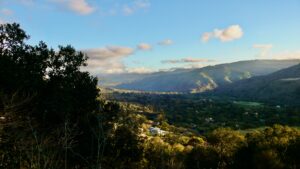
Drive west out of town on Adelaida Road as it climbs into the limestone hills. About fifteen minutes out you reach Parrish Family Vineyard, where fourth-generation grower David Parrish — whose great-grandfather Earl Henderson planted grapes in the region a century ago — built a handsome estate winery and tasting room amid the vines in 2018. The cabernets are the calling card; the terrace, looking over the Adelaida District’s folded hills, is the reason to stay for a second pour.
Then continue the loop toward York Mountain, where the region’s whole story is compressed into one remarkable building. Andrew York planted vines here in 1882 and established what became the first bonded winery on the Central Coast; his family worked the property for more than eighty years. Today it belongs to Epoch Estate Wines, founded in 2004 by geologists Bill and Liz Armstrong, who restored the original winery — its redwood beams, its bricks fired on the property in 1906 — into one of the most striking tasting rooms in California. To taste Epoch’s Rhône-inspired wines inside walls that have held wine since the Cleveland administration is to understand Paso’s particular gift: the new planted carefully inside the old. (Tastings at both estates are by appointment — the region’s gentle way of keeping crowds at bay — so call ahead.)
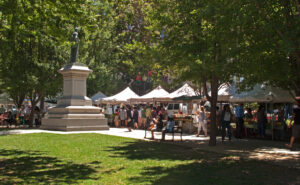
Return to town by late afternoon, nap or swim, and take the evening slowly. The downtown square holds more than a dozen tasting rooms for those still curious, but there is no shame in a bench in the park under the oaks, watching a small town do its Saturday-evening rituals.
Sunday: The long way home
Sunday asks almost nothing of you. Coffee near the park. A last walk around the square, where the storefronts have been serving ranchers and travelers since the railroad arrived in 1886. Perhaps a final tasting at one of the downtown rooms, most of which open by late morning.
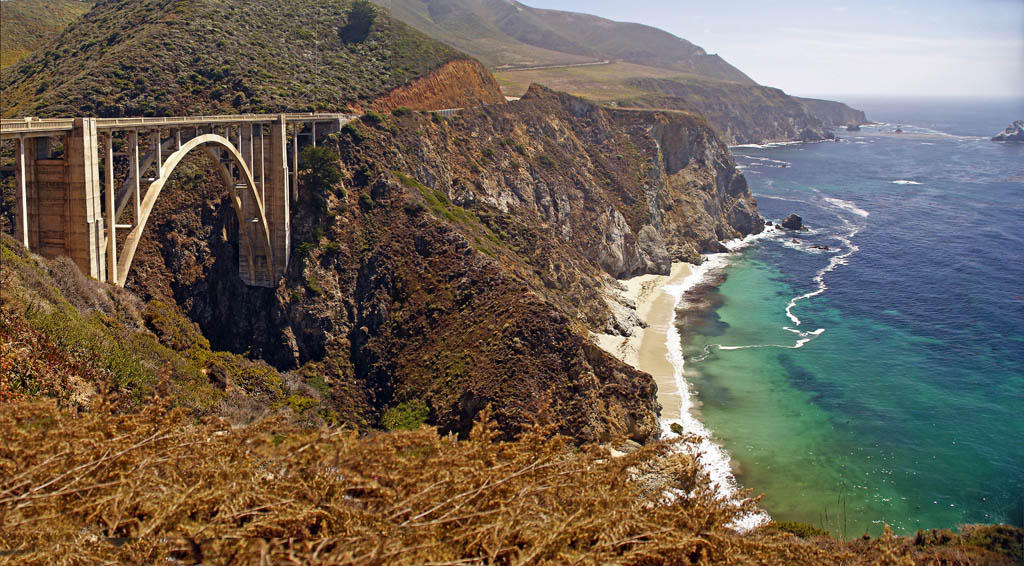
Then, the choice that makes this weekend complete: skip the highway home. Take Highway 46 West over the coastal ridge — one of the Central Coast’s quietly spectacular drives, vineyards giving way to pasture giving way, at the crest, to a sudden blue immensity of Pacific — and join Highway 1 at Cambria. With the coast road fully open again, the return to Carmel becomes not a drive home but a second journey entirely: Piedras Blancas, Ragged Point, the whole Big Sur run unspooling northward as the afternoon light turns gold.
You will arrive home later than the inland route would have allowed, and gladder for it. That, in the end, is the Paso Robles proposition: a weekend built not around what you saw, but around how slowly you moved through it.
Grace notes
The season: Late summer into fall is Paso’s golden hour — harvest energy in the vineyards, warm days, cool nights. Summer afternoons run hot on the eastside; the westside hills and the coast-cooled Templeton Gap stay gentler.
The table worth booking: Les Petites Canailles, Friday night, early enough to walk the square afterward.
The rhythm: Two nights, one wine road, no more than two tastings a day. Paso rewards restraint — a lesson its best winemakers learned long ago.