By Julian Marsh
There are houses that are designed and houses that are confessed. Tor House, the granite cottage the poet Robinson Jeffers raised with his own hands on the low rise of Carmel Point, belongs firmly to the second kind. Walk its walls and you are not reading a floor plan; you are reading a life — its griefs, its devotions, its long argument with the sea. Few buildings in California are so plainly autobiography set in stone.
The story begins in 1914, when Jeffers and his wife, Una, first came upon the unspoiled coast south of the Monterey Peninsula and understood, in Jeffers’s own phrase, that they had found their “inevitable place.” The point was then nearly bare — wind-scoured, treeless, edged by the granite shelves of Carmel Bay. Most would have seen a hard prospect. The Jeffers saw a home, and, gradually, a vocation.
An Apprenticeship in Granite
Jeffers did not arrive a builder. Born in 1887 and educated in languages, medicine, and forestry before poetry claimed him, he came to masonry the way a curious man comes to any craft: by watching, then by doing. For the first house he hired Michael J. Murphy, the Carmel contractor who had been raising local homes since 1902, and a Monterey stone mason. Rather than stand apart as client, Jeffers apprenticed himself to the work, learning, in the words that have followed him ever since, how to make “stone love stone.”
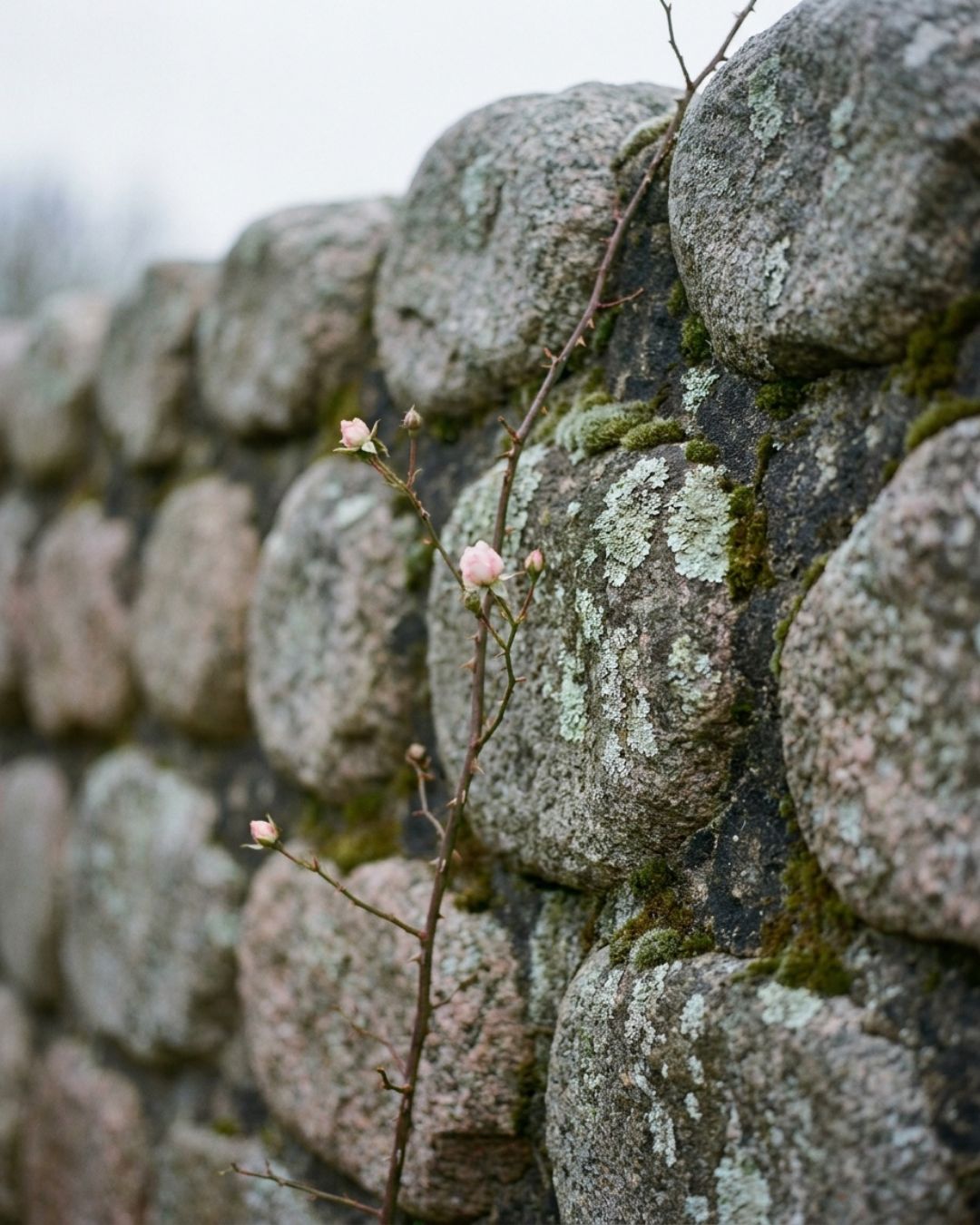
The choice of material was itself a coastal argument. The builders weighed the soft Carmel chalkstone favored elsewhere in the village and set it aside; they had heard it did not hold against heavy weather. Instead they turned to the granite lying in the cove directly below the lot — sea-rounded boulders, gray and pink and salt-bright, hauled up the slope by horse. To build with that stone was to build with the place itself, the same rock the surf was still working a hundred feet away. Tor House was finished in 1919. Its name comes from the English word tor, a craggy knoll of rock — the very ground it stands on.
The cottage is low and unassuming, a compact English-style dwelling with steep gables and small windows set deep in thick walls, more Cornwall or the west of Ireland than California. That was intentional. Una’s imagination ran to Celtic and medieval things, and the house answers her as much as it shelters her. Inside, the scale is intimate, the timber honest, the light admitted in careful measures — a house made for weather and for reading, for a family turned inward toward the hearth while the wind did its work outside.
Hawk Tower, and a Gift Made of Rock
Then, in 1920, Jeffers began the work that would make him legend. Beside the house he started to raise a tower — a gift for Una, whose love of Irish literature and of the old stone towers of Ireland he meant to honor. Alone now, without hired hands, he lifted the granite block by block, a poet in the morning and a mason in the afternoon. It took him four years. Hawk Tower was completed in 1924.
The name arrived by grace. A hawk had kept him company through the building, circling the rising stone; on the day the tower was finished, the story goes, the bird disappeared. What Jeffers left is a small romantic keep of unmistakable character: some forty feet of coursed granite, an open battlemented platform, a turret set to one side, and — the detail every visitor remembers — a secret interior staircase. From the little entry chamber a stair winds up toward Una’s room, so narrow at its tightest that you must lead with your left shoulder to pass. For the Jeffers twins, Donnan and Garth, it was the finest thing a father ever built.
The tower is also a reliquary. Una and the boys pressed keepsakes into its fabric — a plaque above the fireplace holds a fragment of black lava from Kilauea, white lava from Vesuvius, an arrowhead from Michigan, a pebble from the Pennsylvania shore of Lake Erie. Elsewhere a piece of the Great Wall of China is set into the wall. Here is the whole method of Tor House in miniature: a building that remembers, that gathers the world’s stones into one wall and calls it home. This is vernacular architecture in its truest sense — made of what lies nearest, shaped by the hands that will live inside it, owing nothing to fashion and everything to place.
The Old-World Garden
A house so rooted asks for a garden to match, and the Jeffers planted one against the bare wind. Where the point had stood open, Jeffers set out something on the order of two thousand trees — Monterey pine, Monterey cypress, eucalyptus — a forest raised from nothing to shelter the family he was building the walls for. Around the cottage Una tended the close, romantic plantings of an old-world garden, the kind of layered, informal green that seems to have grown up with the stone rather than been arranged beside it. Today that garden remains one of the quietest pleasures of a visit: roses and coastal plants gathered against the granite, the trees now grown tall enough to murmur, the whole composition an unbroken line drawn from tide pool to hearth to canopy.
It was within these walls that Jeffers wrote nearly all his major work, the long narratives and the hard, luminous short poems that made him one of the essential American voices of his century. Craft was never far from his subject. In “To the Stone-Cutters” he addressed his own trade across the ages — “Stone-cutters fighting time with marble, you foredefeated / Challengers of oblivion” — knowing that stone, too, is finally mortal, and building anyway. Tor House is that poem made literal: a wager against time laid down one granite course at a time.
Visiting Tor House
The Robinson Jeffers Tor House Foundation now keeps the house, the tower, and the garden, and opens them to the public through docent-led tours. The Foundation runs these hour-long tours on a limited weekly schedule — currently Saturdays, with limited availability on Fridays — and keeps each group small, no more than six guests, so that the intimacy of the rooms survives the visit. Days and start times shift over time, so check torhouse.org for the current schedule and reserve in advance; because the point remains a residential neighborhood, the grounds are otherwise closed, though the tower is a fine sight from the street any day.
Go on a gray morning, when the light is the color of the walls and the surf is loud in the cove where the stones came from. Stand in the narrow stair, put your left shoulder forward, and climb. You will not find a monument. You will find a house — a poet’s true and stubborn answer to the coast, still standing, stone loving stone.
Tor House and Hawk Tower, 26304 Ocean View Avenue, Carmel-by-the-Sea. Docent tours run on a limited weekly schedule in small groups, by reservation; check the Tor House Foundation (torhouse.org, (831) 624-1813) for current days, times, and tickets.