By Graham Ashford
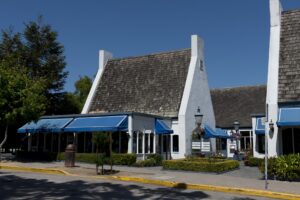
You arrive at La Playa the way you arrive at few places anymore — on foot, a little breathless, with the sea somewhere behind you and salt still on your lips. Carmel-by-the-Sea rewards those who walk it, and the walk up from the beach, two gentle blocks along Camino Real to the corner of Eighth Avenue, is the right way to come to this house. Because it is a house, first and always, before it was ever a hotel. You feel that the moment the stone façade rises into view, unhurried and sure of itself, the way old money and old love tend to be.
They call it the Grande Dame of Carmel, and for once the phrase is earned. La Playa has stood on this corner since 1905, longer than the town around it has been an incorporated place, longer than most of the cypress that now shelters it. To sit in its garden on a late-summer afternoon, with the light going gold and the fog holding its breath somewhere out over Point Lobos, is to sit inside more than a century of Carmel’s own becoming.
A house built for love
The story begins, as the best Carmel stories do, with an artist. Christian Jorgensen was a Norwegian-born painter who had made his name capturing the California landscape — the missions, the mountains, the coast — with the devotion of a man who had found his subject and meant to spend a life on it. In 1905 he built a two-story stone mansion on the southwest corner of what was then a nearly empty stretch of Camino Real, and he built it not as a commission or a speculation but as a gift.
The gift was for his wife, Angela. She was a Ghirardelli — a daughter of the San Francisco chocolate family whose name still gilds the city’s waterfront — and Jorgensen gave her a home worthy of the name. It had spectacular views northwest across Carmel Bay toward Pebble Beach, and it had something no other house in Carmel could claim: the town’s first swimming pool. Imagine that, in a village barely finding its feet, a private pool set among the pines above the sea. It tells you everything about the confidence with which this house was conceived. It was never meant to be modest.
Jorgensen and Angela’s Carmel was a bohemian one, a place where painters and writers came to live cheaply and think grandly, and their stone house on the corner became a kind of anchor for that world — solid, permanent, a fixed point among the artists’ cabins and the sand roads.
From private house to public grace
Time did to the Jorgensen house what it does to all houses of a certain scale: it outgrew a single family. In the years that followed, the mansion passed into the hands of Agnes Signor, who saw in its generous rooms and its garden and its view a different future. She opened it first as a boarding house, and then, in 1922, built it out with additional rooms into a proper full-service hotel. What had been one family’s home became a place where anyone might come and stay a while.
That, more than any renovation since, is the transformation that matters. It is the moment La Playa stopped belonging to one story and started collecting everyone else’s. A hundred summers of arrivals and departures, of honeymoons and homecomings, of long lunches that drifted into longer afternoons in the garden. The hotel grew over the decades into the property you find today — seventy-five rooms wrapped around courtyards and terraced gardens, still on the same corner, still two blocks from the same beach.
The restoration
A house this old is a responsibility, and the most recent stewards of La Playa understood it as one. In 2020 they engaged Post Company, a design firm known for handling historic bones with a light and intelligent hand, and over the next three years the hotel underwent a roughly fifteen-million-dollar restoration, completed in the autumn of 2023.
What impresses about the work is its restraint. The temptation with a grande dame is to make her over entirely, to scrub away the age that is precisely the point. Post Company did the opposite. They touched all seventy-five guest rooms, the public spaces, the gardens and the event venues, but the aim throughout was to preserve the turn-of-the-century spirit rather than paper over it. The details reward a slow eye: solid cast-brass doorknobs that fill the hand, tasseled cabinet pulls, paintings that feel chosen rather than ordered. Modern comforts were folded in where they would not intrude — quiet climate control tucked into rooms that still frame the ocean the way Jorgensen intended, sunlit windows opening to the coastal air.
The gardens remain the soul of the place. Intimate patios and secluded courtyards, the tended green that has drawn guests down into it for a century, and at the heart of it the descendant of that first Carmel pool, still catching the late light. Bud’s, the hotel bar, gathers the evening the way a good bar should, unhurried and warm.
The feeling of the place
What you notice at La Playa is not any single luxury but the accumulation of them into something that feels less like a hotel than like being taken in by a gracious and slightly grand old family. There is craftsmanship here, and there is legacy, but the two only matter because they add up to ease. You put your bag down and your shoulders drop.
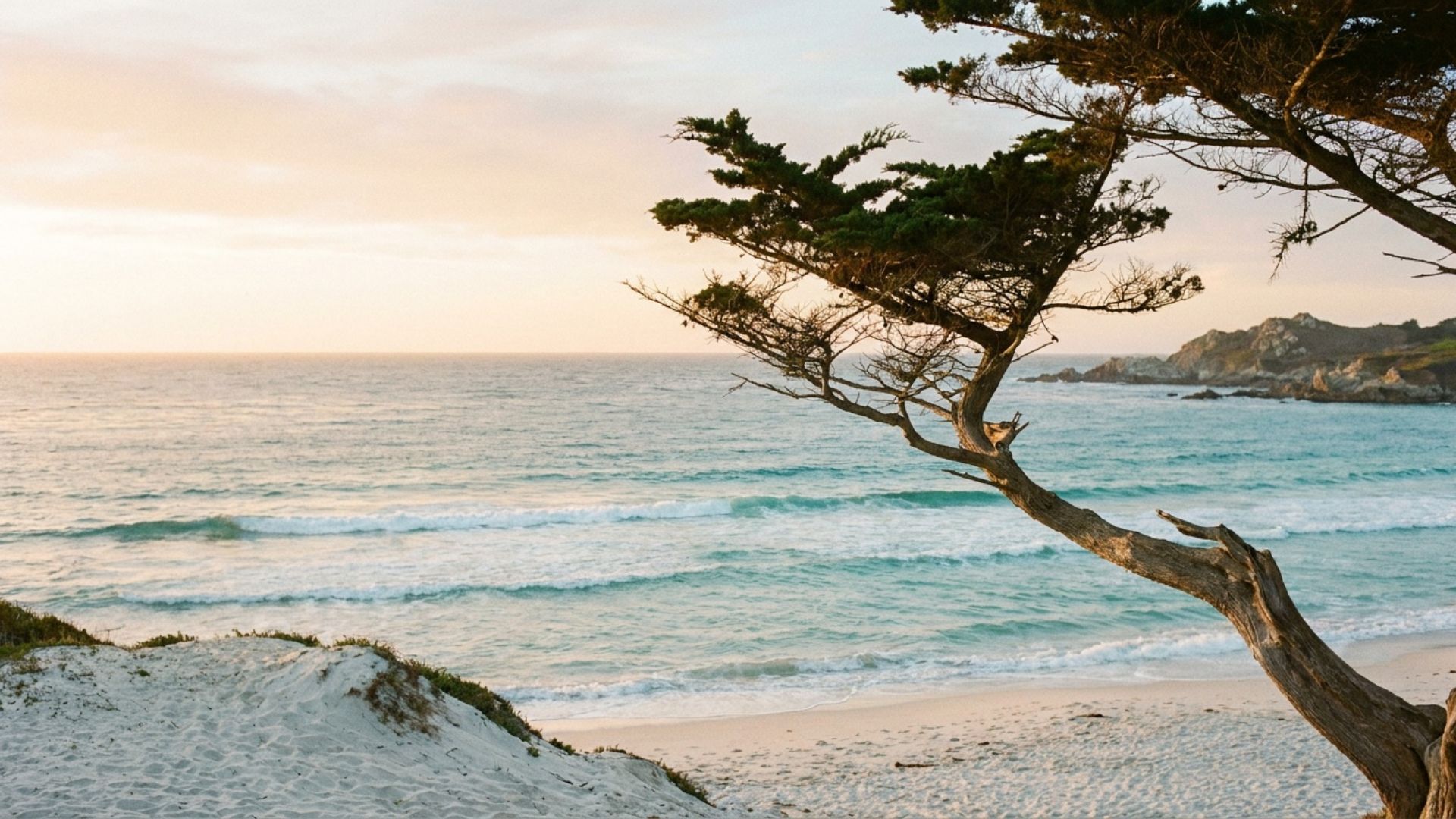
Late summer is the season that suits her best. September in Carmel is the local secret — the fog thins, the days warm, the crowds of August thin with them, and the light takes on the burnished quality that painters like Jorgensen crossed oceans to chase. In the mornings the garden is cool and quiet. By afternoon you can walk the two blocks down to Carmel Beach, white sand and improbable turquoise water and those wind-sculpted cypress leaning out over the sea, and then walk back up to the stone house on the corner as though you lived there. For a few days, you do.
A few practical grace notes, offered without turning this into a ledger. Ask about the northwest-facing rooms if the bay view is what you came for; it is the same one that made Jorgensen build here. Time a visit for the shoulder weeks of September, when the town exhales. And leave an evening unplanned, for the garden and a drink at Bud’s and the particular pleasure of having nowhere else you need to be.
The town of Carmel is full of charming places to lay one’s head, but there is only one house that watched the town grow up around it. The Grande Dame is still here, on her corner, two blocks from the sea, keeping the light. She has been receiving guests for a hundred years. She receives you now.
La Playa Carmel, Camino Real at Eighth Avenue, Carmel-by-the-Sea. Seventy-five rooms; restoration by Post Company completed Fall 2023.